
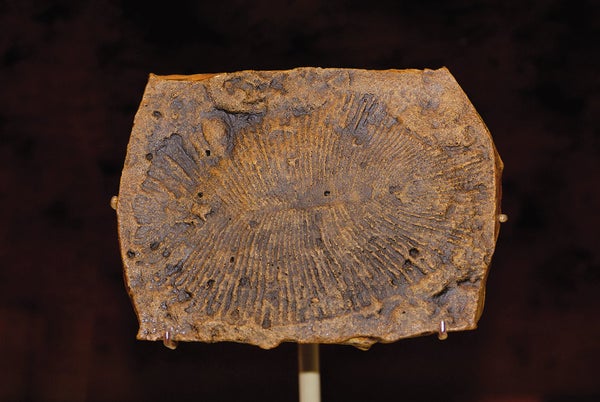
About 550 million years ago animals were relegated to the seas. Microbes and larger multicellular organisms covered much of the seafloor in an organic mat similar to pond scum. On top of this settled bigger animals, including Dickinsonia—a genus of perplexing creatures shaped like dinner plates, round bath mats and flattened coins.
Scientists have long speculated about what Earth's life was like half a billion years ago, during the Ediacaran period, and they are steadily finding more clues. A study published online in June in Geobiology reports that Dickinsonia may have been some of the first complex animals to move on their own in search of food. This finding, experts say, could help us better understand animals' evolution.
Since Dickinsonia were first described in the 1940s, scientists have debated exactly what type of organism they were. “They've been interpreted as everything from a lichen to a worm—a whole variety of things,” says Scott Evans, a paleontology researcher at the University of California, Riverside, and one of the study authors. “Recently it has become apparent that this thing was definitely an animal.” Based on the fossil evidence, scientists think Dickinsonia were soft-bodied and oval-shaped, with multiple body divisions and ribbed upper and lower surfaces. They had a distinct front and back and could grow up to a meter in length but were only several millimeters thick.
On supporting science journalism
If you're enjoying this article, consider supporting our award-winning journalism by subscribing. By purchasing a subscription you are helping to ensure the future of impactful stories about the discoveries and ideas shaping our world today.
Evans and other researchers from U.C. Riverside and the South Australian Museum in Adelaide analyzed nearly 1,500 Dickinsonia fossils to determine whether the animals could move on their own. “People have speculated about [their] being mobile for a while” because of clues in the fossil record, Evans says, “but we wanted to examine the different features we see in Dickinsonia to see if we could eliminate all other possible explanations besides mobility.”
The record includes body fossils as well as what appear to be “trace fossils”—“footprints” of sorts—that these animals left behind, hinting they were mobile. Some scientists suggested, however, that ancient ocean currents may have picked the creatures up and moved them. Others said the “footprint” fossils may have actually formed from specimens that had decayed and then collapsed when buried in sediment.
But Evans and his team determined that Dickinsonia indeed seem to have traveled on their own: possibly tens of meters or more over their lifetime. The fossil record shows that these organisms had all moved in different directions; if ocean currents had shifted them, they would have all been oriented in the same direction, Evans says. The body and trace fossils also reveal specific pathways left by Dickinsonia. If these were left by decayed animals, “we would expect them to be sort of random with respect to one another,” Evans explains. “And the fact that we're seeing trackways [for a single individual] moving in a preferred direction suggests an organism moving under its own power and moving in a direction related to its internal biology.”
The evidence indicates Dickinsonia fed in one spot on the seafloor's organic carpet and then actively sought a fresh food source, and they probably did so on relatively short timescales—over hours or days. Some scientists have hypothesized that these animals moved by expanding and contracting their body using muscles, and the new analysis supports this idea. Evans notes that although scientists have found evidence for self-directed animal movement earlier than Dickinsonia, those animals likely were smaller and traveled shorter distances. And, he adds, “This is the first time we're seeing an animal move to a new location to feed.”
Other researchers say these findings help to resolve some of the debate over Dickinsonia and paint a clearer picture of life's history on Earth. “They killed all the other hypotheses” about whether Dickinsonia moved or not, says Jakob Vinther, a paleobiologist at the University of Bristol in England, who was not involved in the study. “This provides us with more constraints to understand what [these fossils] tell us about the earliest animals and animal evolution.” Paleontologist and mathematician Renee Hoekzema of the University of Copenhagen agrees. “Against all odds we are really starting to resolve fundamental questions about the nature of the enigmatic Ediacara biota and thus gaining insight into the evolution of complex life on the planet,” explains Hoekzema, who also was not involved in the study.
Although Dickinsonia did not look like any known living things today, there are still some parallels between modern animal life and archaic creatures such as these. “We're seeing very early on the development of complex behaviors of mobility and different feeding styles,” Evans says. “These animal communities we find early on in the fossil record are almost as complex as the ones we have today.” Perhaps life on ancient Earth was not so alien after all.