
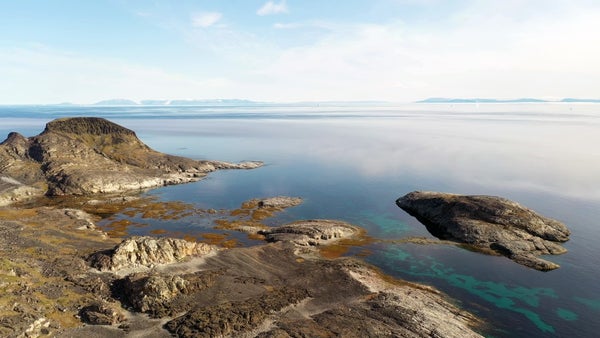
In the pristine High Arctic sits the Kitsissut island cluster, also known as the Carey Islands, nestled between northwest Greenland and northeast Canada. The surrounding seas are perilous, and traveling there is difficult even with modern boats. But new archaeological evidence suggests ancient humans managed to sail to the islands, too.
Early settlers lived on the islands between 4,500 and 2,700 years ago. Archaeologists had long assumed they were land-bound, unable to cross the seas surrounding them after the ice that once blanketed the area had melted. But new research published Sunday in the journal Antiquity suggests these settlers formed seafaring communities that existed for at least as long as the area’s polynya—a technical name for unfrozen water amid sea ice—indicating that humans have long had a hand in shaping the dynamic Arctic ecosystem.
“We saw a space for archaeology to bring forward the deep history of the environment and learn more about stewardship through time,” says the study’s lead author, Matthew Walls, an archaeologist at the University of Calgary.
On supporting science journalism
If you're enjoying this article, consider supporting our award-winning journalism by subscribing. By purchasing a subscription you are helping to ensure the future of impactful stories about the discoveries and ideas shaping our world today.
In the past, archaeologists had assumed humans made their way to the Arctic by following musk oxen and other onshore prey. But though more recent evidence has suggested otherwise, it’s been hard to dispel the old theory, particularly because remnants of boats and fishing supplies—made from organic materials—were largely missing from the archaeological record.
The new study helps fill in some of those gaps. The researchers analyzed 297 archaeological features and artifacts from five localities, primarily on Isbjørne Island in the Kitsissut island chain. The dwellings they found there indicate that humans regularly visited and inhabited the islands, traveling from one to the other and back.
“You’re looking at a trip that’s maybe 15 to 18 hours of difficult paddling and in this environment where things can change on you very quickly,” Walls says. “I think the people who were able to make this trip had an incredible amount of navigational skill and ability.”
The findings reveal the Arctic settlers’ seafaring nature and deep understanding of the waters around them. They also show that humans played a big role in a vibrant ecosystem that emerged after a massive chunk of sea ice unfroze approximately 4,500 years ago—around the same time humans started journeying across it. Every species that has made the area the ecological hotspot it is today—from seabirds and polar bears to seals and toothed whales—would have had some degree of contact with these early human settlers.
The intertwined history of the ecosystem could help inform future conservation efforts, says Sofia Ribeiro, a researcher at the Geological Survey of Denmark and Greenland, who was not involved in the study.
“[The study] will be a good contribution to inform measures for the future,” Ribeiro says.“We need to be looking at stewardship as something that has been happening that is not isolated from the evolution of this ecosystem.”
Walls hopes the work will inform regional officials’ decision-making about environmental stewardship and inspire further study of the region’s lesser-known historical inhabitants.
“I think we’re at a moment where an important platform for archaeology is to help better represent environmental histories that account for cultural stories as well,” Walls says.