
Earth’s surface is a work forever in progress. Boulders tumble down mountain slopes raised by colliding tectonic plates. Glaciers grind the boulders into dust. Wind, rain and rivers carry that dust to the sea, where it becomes sediment. These are among the traditional ways landscapes are known to change. But new research suggests there’s a mighty force of nature missing from this picture: animals.
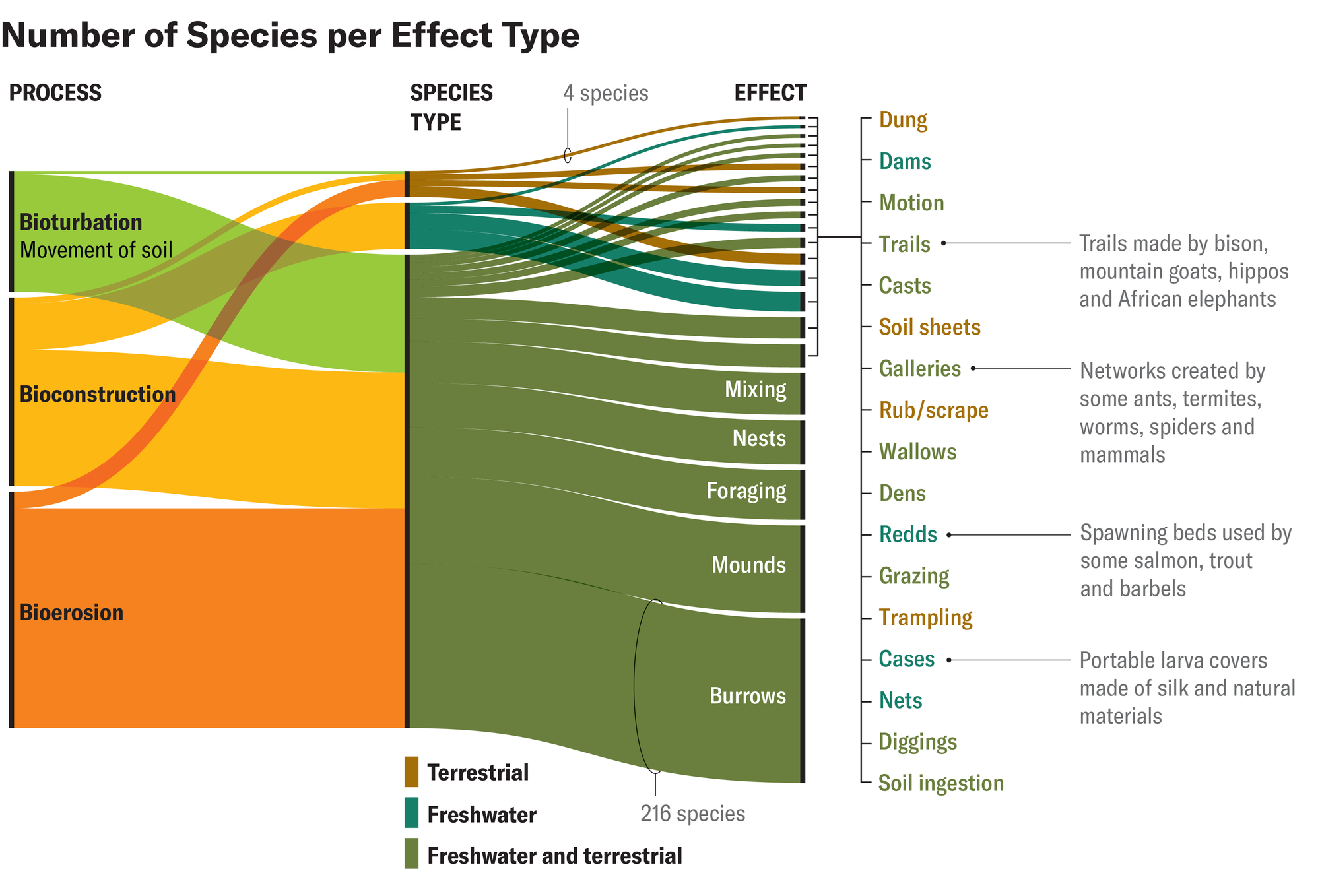
In a study published in the Proceedings of the National Academy of Sciences USA, researchers estimate that wild freshwater and terrestrial species, ranging from salmon to elephants, expend 76,000 gigajoules of energy to alter the land around them every year—the equivalent of thousands of extreme floods.
Beavers are, of course, famous for their engineering feats. But when it comes to other animals, no matter how extensive their nest building or den digging is, “the perception has been that they’re interesting curiosities but really not that important globally,” says the study’s lead author, Gemma L. Harvey, a physical geographer at Queen Mary University of London. “This paper challenges that.”
On supporting science journalism
If you're enjoying this article, consider supporting our award-winning journalism by subscribing. By purchasing a subscription you are helping to ensure the future of impactful stories about the discoveries and ideas shaping our world today.
Ripley Cleghorn; Source: “Global Diversity and Energy of Animals Shaping the Earth’s surface,” by Gemma L. Harvey et al., in Proceedings of the National Academy of Sciences USA, Vol. 122; February 18, 2025 (data)
The study of landform evolution is called geomorphology, and when the changes are caused by animals, we tack on another prefix: zoogeomorphology. As early as 1881, Charles Darwin recognized earthworms’ role in soil formation. But it wasn’t until 1992 that physical geographer David Butler, now a professor emeritus at Texas State University, coined the term for the effect.
He debuted this scientific mouthful that year in a paper on “the grizzly bear as an erosional agent,” in which he calculated that the bears in Glacier National Park had, over the course of 100 years, moved about 15,000 dump-truck loads of dirt downslope while foraging for food and excavating their dens. “It made me suspect that if you did this worldwide for hundreds of species, you would come up with astonishing numbers,” he says.
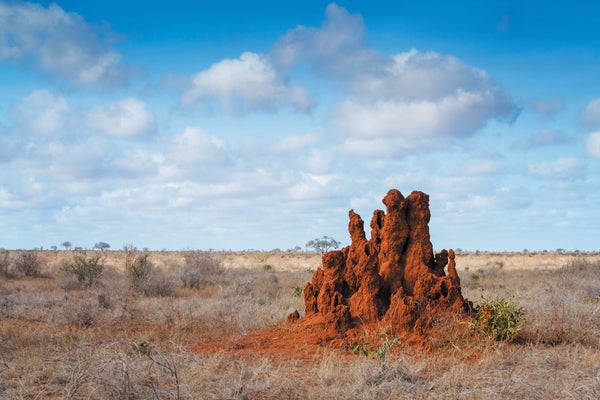
The data needed for this kind of investigation weren’t available then, but three decades later Harvey’s team found enough to analyze 500 species. The researchers learned that trampling hippos create entirely new river channels, and burrowing crayfish widen the banks of existing ones. They found that hulking termite mounds cover an Iceland-size patch of Brazil. “Those are huge areas,” Harvey says, “huge amounts of soil being transformed.”
Brian Yanites, a geomorphologist at Indiana University Bloomington, who was not involved in this study, notes that such research is often hyperlocalized to “one type of animal, one specific location or particular landform.” But he says the new work “is a really elegant way to approach the problem from a macro level.”
If anything, the authors think 76,000 gigajoules is probably a wild underestimate; they excluded vast biodiversity hotspots in Africa, South America and Asia because there are few published studies on how living creatures reshape lands in those regions. Although many experts disregard animals as a source of profound landscape change, Butler says, “I think this study could be a ‘Holy crap!’ moment for them.”