
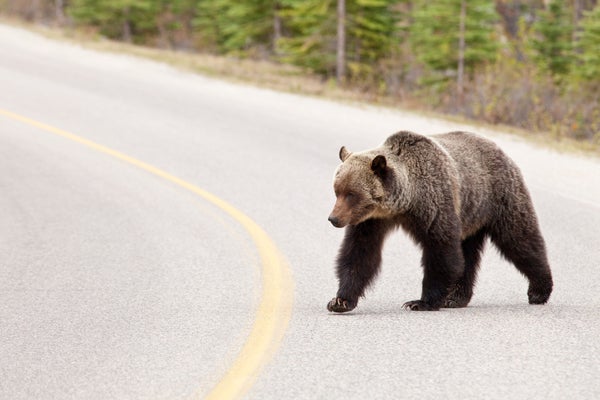
Animals living in landscapes used intensively by people travel, on average, only half to one-third as far as animals in more remote areas do—a pattern that's consistent across dozens of species worldwide. The finding, published today in Science1, has implications for important ecological processes linked to animal movement, such as seed transport and nutrient cycling. And it could spell trouble for the animals themselves as the climate changes.
More than 100 scientists around the world shared satellite-tracking data for 803 mammals from 57 species, from impala (Aepyceros melampus) to olive baboons (Papio anubis) and grizzly bears (Ursus arctos). The data charted the animals’ movements over timescales of up to ten days, and were correlated with a Human Footprint Index that measures how deeply our species has impacted a place, using metrics such as population density and the presence of roads and night-time lights.
There’s likely to be more than one explanation for the animals’ reduced mobility, says Marlee Tucker, a macro-ecologist at Goethe University in Frankfurt, Germany, who led the study. “Some animals might be sort of trapped, caught in fragments that are suitable for them, surrounded by a landscape that is not suitable—a road, a fence or a lot of people.” But others might be tethering themselves to attractive resources, such as edible crops or water sources intended for livestock.
On supporting science journalism
If you're enjoying this article, consider supporting our award-winning journalism by subscribing. By purchasing a subscription you are helping to ensure the future of impactful stories about the discoveries and ideas shaping our world today.
Sticking close to calories
That helps to explain the behaviour of a herd of elk (Cervus elaphus) near Banff National Park in Canada tracked by ecologist Mark Hebblewhite of the University of Montana in Missoula. Many have stopped migrating between summer and winter range. “They’ve given up their old wild ways,” Hebblewhite says. The same dynamic is playing out with migrating ungulates across the western United States and Canada, Hebblewhite says. Many now spend the summer feasting on irrigated alfalfa crops in areas they once abandoned in warm months. “The point of migrating was to get access to what’s under that [sprinkler] in August”—calories.“
Reduced movement can affect ecosystems because it means that seeds and nutrients in dung might not be spread so widely, or because herbivores such as elk graze smaller areas more intensively. It can affect the animals, as well: crowding together in a small area could increase the risk of disease. “It is definitely concerning,” Tucker says.
Conservation biologist Reed Noss, president of the Florida Institute for Conservation Science in Chuluota, says the findings underscore the importance of corridors of land that allow wildlife to move between core areas of habitat. As the climate changes and the seas rise, these features enable animals to search widely for food and mates—and eventually seek more hospitable climates.
A helping hand
Where human barriers such as roads and cities can’t be perforated with wildlife corridors, or where animals can’t move quickly enough to keep up with changes in their environment, some species may need help moving, Noss says. “It seems like we will have little choice but to intervene if we don’t want to lose species.”
Hebblewhite says that knowing that human activity is reducing species movement “galvanizes” him to fight for more wildlife-friendly open space—even rail-thin corridors—to help animals roam. “It is going to be tough to make big new protected areas in the twenty-first century,” he says. But it is possible to build new connections, such as wildlife overpasses across highways, and to protect existing slivers of habitat criss-crossing cities and farms that can serve as corridors. Even convincing ranchers to leave their gates open in the winter when cattle aren’t around can help, says Hebblewhite, by allowing pronghorn antelope to migrate with the seasons.
Tucker adds that migration is one of the world's great natural wonders and deserves to be protected for its own sake. “It would be a real shame if we modified the landscape so much that you didn’t have that joy of knowing that the animals travelled so far,” she says. "And nature documentaries wouldn’t have that great footage anymore.
This article is reproduced with permission and was first published on January 25, 2018.