
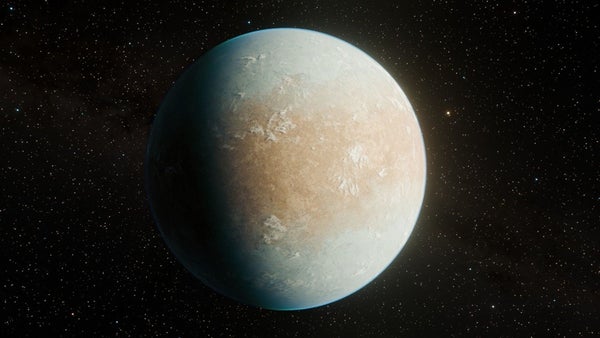
Astronomers think they’ve found a celestial unicorn: a potentially habitable near twin of Earth with the same size and perhaps even year-length as our own familiar planet, circling a star much like our own. The only problem is that they’re not sure it’s really there.
The first—and so far only—hint of the potential planet arrived in observations from NASA’s now retired Kepler space telescope. In 2017 the telescope recorded a sudden 10-hour-long dimming of HD 137010, a star only slightly less massive and luminous than our sun that is located some 146 light-years away in the constellation of Libra. Initially flagged by volunteers sifting through archival Kepler data as part of the crowdsourced Planet Hunters project, the signal matched the profile of a tiny, rocky exoplanet passing—or transiting—in front of the star. After further analysis, a team of astronomers reported the possible discovery on Tuesday in the Astrophysical Journal Letters.
If confirmed, this world would officially be called HD 137010 b—but confirmation has proved difficult, to say the least.
On supporting science journalism
If you're enjoying this article, consider supporting our award-winning journalism by subscribing. By purchasing a subscription you are helping to ensure the future of impactful stories about the discoveries and ideas shaping our world today.
Kepler’s search strategy was to stare at a rich field of stars for years on end. By watching for telltale transits, it discovered thousands of exoplanets. Stars can dim for many nonplanetary reasons, however. So the mission’s scientists sought a total of three observed transits for Kepler’s smallest planetary candidates before the researchers would declare them to be genuine worlds. This time-consuming process was cut short a few years into the mission when the telescope’s stabilizing instruments failed, forcing NASA to switch Kepler’s field of view to new patches of sky. This new phase of the mission was called K2, and each of its campaigns only lasted about 80 days. One of them brought the sole known transit of HD 137010 b.
By the time anyone noticed that single, tantalizing signal in Kepler’s vast dataset, the telescope had been mothballed, decommissioned into a graveyard orbit after running out of fuel.
“The authors have tried to rule out everything they can from the data, but with only one transit, you can only do so much,” says Jessie Christiansen, an astrophysicist at the California Institute of Technology.
“There’s always something that could go wrong with a single transit,” says Andrew Vanderburg, an astronomer at Harvard University, who co-authored the study. “That being said, it’s a very strong signal—it looks like a planet.”
Vanderburg and his colleagues did manage to roughly gauge the candidate’s orbital speed—and with that, constrain its plausible orbital period and distance from its star. But even so, HD 137010 b could have a year lasting anywhere from about 300 to 550 days, the authors say. That huge range not only complicates the search for more transits; it also means this notional near twin of Earth could be so far from its slightly dimmer star that it would instead be more like a frozen, supersized version of Mars.
Confirmation seems unlikely, for now. No other exoplanet-hunting telescope currently plans to even look at the star, let alone scrutinize it long enough to bag more transits. “Two transits is a maybe, but three transits is exactly what you want,” Christiansen says. “It’s a little soon to fire up the rockets and head for this star.” But because the star is so relatively bright and nearby in the Milky Way, it could make a desirable target for future planned observatories that will be capable of finding small exoplanets by taking their pictures.
Yet even that might be a stretch. Why devote a multibillion-dollar space telescope to looking for a possible planet when other, more certain worlds could be studied instead? Vanderburg points out as well that even some exoplanets that had previously been thought to be confirmed via three transits have turned out to be likely mirages. This one seems different, though, because of the strength and clarity of its sadly solitary signal. “I feel better about that one transit than I feel about multiple transits from some of these other systems,” he says.
Still, he wishes the astronomers planning Kepler’s original mission could have magically foreseen what this otherwise unremarkable star may be hiding. “If we’d stared at it for four years,” he says, “this would have been the ‘Earth 2.0’ that no one could dispute.”