
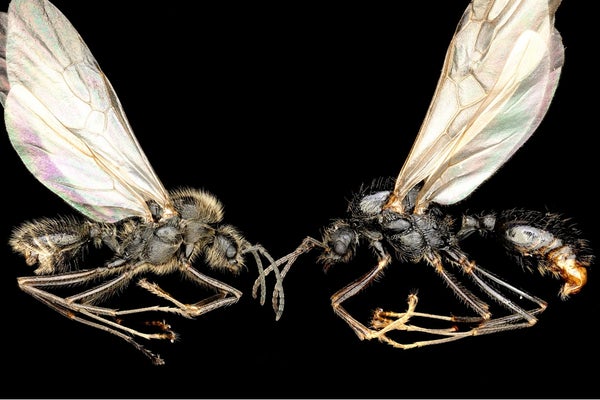
A common type of ant in Europe breaks a fundamental rule in biology: its queens can produce male offspring that are a whole different species. These queen Iberian harvester ants (Messor ibericus) are sexual parasites that rely on the sperm of males of the ant species Messor structor. They use this sperm to breed an army of robust worker ants, which are hybrids of the two species.
Data now show that, in the absence of nearby M. structor colonies, M. ibericus queens can clone male M. structor ants by laying eggs that contain only M. structor DNA in their nuclei. The findings were published in Nature on 3 September.
“It’s an absolutely fantastic, bizarre story of a system that allows things to happen that seem almost unimaginable,” says Jacobus Boomsma, an evolutionary biologist at the University of Copenhagen.
On supporting science journalism
If you're enjoying this article, consider supporting our award-winning journalism by subscribing. By purchasing a subscription you are helping to ensure the future of impactful stories about the discoveries and ideas shaping our world today.
DIY cloning
Iberian harvester ants co-exist with M. structor in some parts of Europe, which has historically given M. ibericus queens an abundant supply of M. structor males to mate with.
But evolutionary biologist Jonathan Romiguier at the Institute of Evolutionary Science of Montpellier in France and his colleagues noticed something strange on the Italian island of Sicily: they found Iberian harvester ants everywhere but not a single colony of M. structor.
When the researchers peered inside colonies of the Iberian harvester ant, they found two types of ant that looked very different. Genetic analyses confirmed that the colonies contained both M. ibericus and M. structor, despite the lack of M. structor populations on the island.
Further analyses solved the mystery: Iberian harvester queens clone M. structor ants to maintain a supply of their sperm. They then mate with those M. structor ants to produce hybrid workers that take care of the colony, including by building the nest and foraging for food. In effect, M. ibericus has domesticated M. structor and its genome, Romiguier says.
The two species diverged more than five million years ago, so it’s wild to see one species producing the other, Romiguier adds. “That’s almost how long ago humans and chimpanzees diverged.”
Intriguingly, when the researchers put the M. structor ants cloned by the Iberian harvester ants into a regular M. structor colony, the insects were killed for being foreign invaders, despite looking nearly identical to those in the colony. That’s because the cloned ants carried the pheromones of their Iberian cousins, so they were treated as enemies, Romiguier says. Another way that they are different from the ants in the M. structor colony is that, although the clones have only M. structor DNA in the nuclei of their cells, they carry M. ibericus DNA in their mitochondria — the cells’ energy-producing units.
A successful partnership?
Romiguier says that this domestication of the M. structor genome resembles the beneficial partnership that led to mitochondria becoming part of the eukaryotic cell more than one billion years ago after a primitive host cell engulfed a bacterium. Today, eukaryotes — which include all animals, plants and fungi — also have two distinct genomes in their cells: one in the nucleus and one in the mitochondria. But Boomsma does not expect M. ibericus’s rare sexual parasitism to be nearly as evolutionarily successful as eukaryotes’ acquisition of mitochondria and spread to other organisms.
“Ants are just amazing and force us to be open-minded to allow the discovery of unorthodox mating systems,” says Claudie Doums, an evolutionary ecologist at the Practical School of Advanced Studies in Paris.
This article is reproduced with permission and was first published on September 3, 2025.