
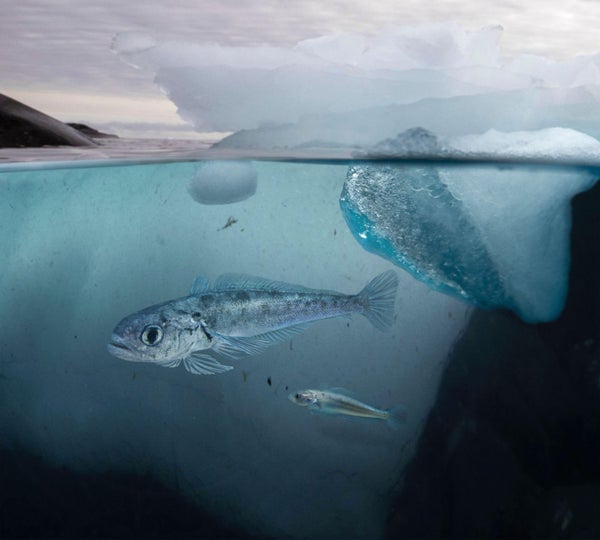
Blood doping to heighten performance is forbidden in professional sports. Athletes can use this technique to fuel their muscles with more oxygen-carrying red blood cells—for example, by receiving a transfusion. But many animals dope naturally: sheep, marine fishes and horses can boost their blood's capacity to carry oxygen by 16 to 74 percent in physically demanding situations. Now a study shows that an Antarctic fish called the bald notothen can ramp up its carrying capacity by more than 200 percent to pursue an active life in frigid waters.
Like most fishes native to Antarctica, the bald notothen's blood contains antifreeze proteins that help it withstand extreme cold. But these proteins, along with red blood cells (RBCs), can make blood viscous and hard to circulate. Some Antarctic fishes adapt by eliminating RBCs altogether, absorbing oxygen directly from the water via gills and skin as they passively await prey. Bald notothens, however, actively swim below surface ice to chase krill and other crustaceans while dodging predators such as penguins and seals. For this behavior, “you need to supply [more] oxygen to the muscles,” says Michael Axelsson, a cardiovascular physiologist at the University of Gothenburg in Sweden and co-author of the new study, which was published in January in the Journal of Experimental Biology.
The scientists compared RBC levels in samples collected from bald notothens relaxing in glass tanks with those in samples drawn from fish they “chased” using a plastic tube. RBC levels were at 9 percent in the resting animals but 27 percent in the exercised ones, showing a 207 percent spike in the latter's blood oxygen-carrying capacity. “No [other] fish we've seen can more than double their RBCs or drop their numbers to such a low level when resting,” Axelsson says. This low level reduces strain on the bald notothens' heart, he adds. The fish's spleen stores RBCs, and the researchers found that to eject more into the bloodstream, the organ contracts to weigh 41 percent less.
On supporting science journalism
If you're enjoying this article, consider supporting our award-winning journalism by subscribing. By purchasing a subscription you are helping to ensure the future of impactful stories about the discoveries and ideas shaping our world today.
The enormous changes in RBC levels initially surprised Gerald Kooyman, a marine biologist at the Scripps Institution of Oceanography, who was not involved in the study. He notes, however, that these animals have fewer blood cells to begin with, so maintaining circulation with a tripled RBC count is less difficult. If a diving Weddell seal pushed its RBC levels from 40 to 90 percent, for instance, its blood would be dangerously hard to pump.
Yet bald notothens do face trade-offs for their ability. By attaching a probe to each fish's aorta, the scientists found blood pressure was 12 percent higher and the heart worked 30 percent harder in active individuals. The heart can rest during quiet times, but when bald notothens need to exert themselves, Axelsson says, “these fish have to live with the slightly higher consequences of [more] RBCs because they need more oxygen.”