
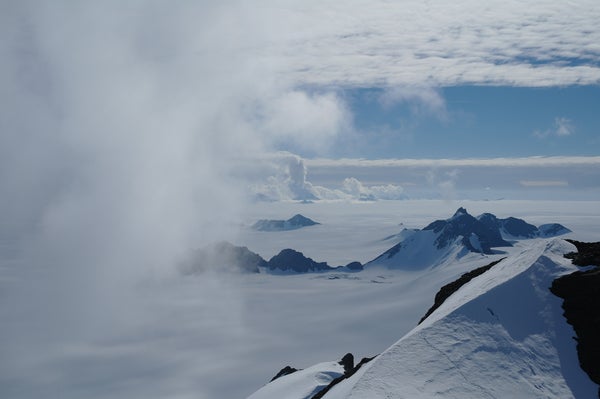
The Antarctic ice sheet lost a whopping 3 trillion tons of ice between 1992 and 2017, scientists announced this week.
That’s the equivalent of about 8 millimeters of sea-level rise. It might sound small, but scientists say the significance is huge.
Most alarmingly, the losses are speeding up. Since 1992, annual ice loss from the Antarctic Peninsula has more than doubled, and it’s tripled in West Antarctica. Much of that increase has occurred in the last five years alone.
On supporting science journalism
If you're enjoying this article, consider supporting our award-winning journalism by subscribing. By purchasing a subscription you are helping to ensure the future of impactful stories about the discoveries and ideas shaping our world today.
The findings were published yesterday in Nature by an international team of more than six dozen researchers, all part of the Ice Sheet Mass Balance Intercomparison Exercise. It’s a collaborative project, supported by both NASA and the European Space Agency, focused on improving estimates of changes on the Greenland and Antarctic ice sheets.
“We can clearly see that the rate of ice losses have increased,” said Andrew Shepherd of the University of Leeds, who led the effort.
As a result, he said, future sea-level-rise projections from the Intergovernmental Panel on Climate Change may be too low.
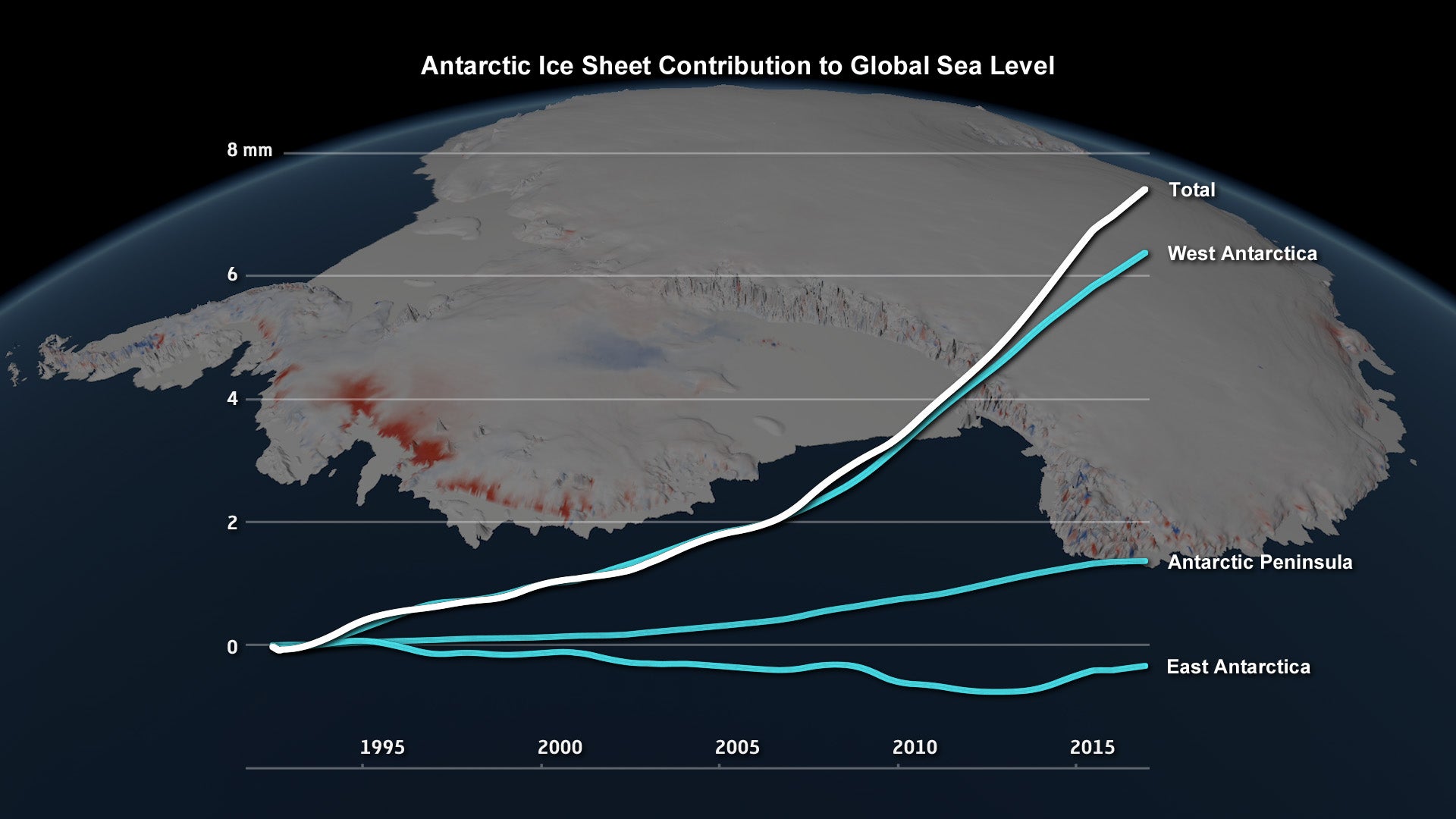
Sea level contribution due to the Antarctic ice sheet between 1992 and 2017. Credit: imbie and Planetary Visions
Previous model assessments have provided a range of possible future contributions from the Antarctic ice sheet through the next century. At their lower bounds, they predict no contribution at all, suggesting that ice loss from the continent’s glaciers will be offset by an increase in snowfall. At their higher bounds, they suggest losses equivalent to about 15 centimeters or so of sea-level rise, Shepherd said.
“What the changes that we’ve seen mean is that, whereas before we thought Antarctica was tracking the lower bound, it’s pretty clear now that it’s tracking the upper bound,” he told E&E News.
The new study draws on two dozen satellite estimates of Antarctic ice mass changes over the past 25 years. The paper builds on a similar 2011 study published in Science but adds more data and extends the study period to 2017.
The previous paper found that Antarctica had been losing ice at a rate of about 71 billion tons per year—suggesting a total loss of nearly 1.5 trillion tons between 1992 and 2011. The new study, with its updated data, suggests the losses during that time period were perhaps a little higher, but generally similar—and much of the additional ice loss has actually occurred in the years since 2011.
This find “was definitely a surprise,” Shepherd said.
Until recently, the greatest concern about future sea-level rise has centered on accelerating ice loss in Greenland, which some research suggests lost about a trillion tons of ice between 2011 and 2014 alone. The updated assessment suggests that Antarctica is quickly becoming a more significant factor.
That said, ice loss across the continent is far from uniform. East Antarctica, by far the largest section of the ice sheet, has remained largely stable over the study period—although research suggests that this region may be starting to lose more ice, as well. Some recent studies have noted high melt rates at East Antarctica’s massive Totten Glacier, sometimes referred to as Antarctica’s “sleeping giant” because of its immense potential contributions to sea-level rise.
For now, though, the vast majority of the losses comes from vulnerable West Antarctica, where the intrusion of warm ocean water is melting some glaciers from the bottom up, causing accelerating rates of ice loss (Climatewire, April 10).
Much of the focus on West Antarctica currently centers on a few large glaciers—namely, Pine Island Glacier and Thwaites Glacier, which together account for a majority of the ice being lost from the region. Thwaites is currently the subject of a joint research initiative between the National Science Foundation and the British Natural Environment Research Council, which will conduct a series of field missions aimed at exploring the massive glacier’s potential contributions to future sea-level rise.
Currently, the study suggests West Antarctica as a whole is losing ice at a rate of about 159 billion metric tons each year—up from 53 billion tons in 1992. Combined with the ice loss from the Antarctic Peninsula, the continent as a whole is losing about 200 billion tons per year. That’s about triple what it was in 1992.
The sea-level-rise contribution—8 millimeters in 25 years—may “seem to be quite small,” Shepherd noted. But what’s important is the rate at which the total ice loss has been accelerating in the last few years alone. On a century time scale, those losses—should they continue to accelerate—could add up to a formidable contribution to future sea-level rise.
For now, it remains to be seen whether the current accelerating trend will continue. And future patterns of ice loss in Antarctica may not necessarily occur in an even, linear fashion, according to Knut Christianson, an ice sheet expert at the University of Washington, who commented on the new research.
Even since 1992, there’s been a great deal of variation in the ice sheet’s losses from one year to next, he noted. The ice sheet, particularly in West Antarctica, can respond very quickly to small changes in ocean temperatures and other variables, with rates of ice loss temporarily speeding up and slowing down accordingly. Additionally, glaciers don’t always retreat smoothly. Because they rest on even bedrock, the ice tends to move more quickly over some patches and slow down or temporarily halt when it encounters a bump, leading to uneven patterns of movement over time.
Altogether, it can take years of monitoring to determine what the long-term trend in ice loss is going to be—a testament to the importance of keeping continuous, long-term time series, Christianson suggested.
For now, though, the new data may have heightened concerns about what the future may hold. Overall, the new research indicates that Antarctica’s contributions to global sea-level rise may be “up to 30 percent and rising,” Shepherd said. “And that makes us think again about projections for the future.”
Reprinted from Climatewire with permission from E&E News. E&E provides daily coverage of essential energy and environmental news at www.eenews.net.


