
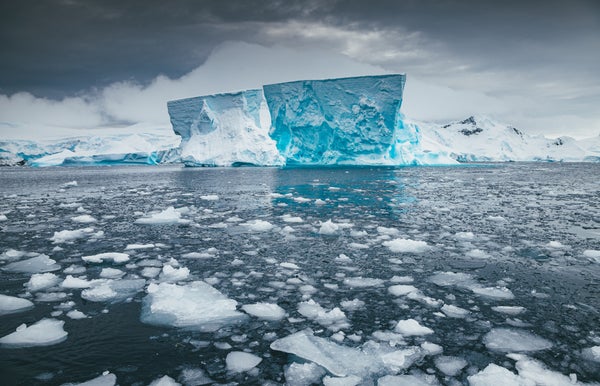
CLIMATEWIRE | Antarctic sea ice shrank to an all-time record in February — the smallest it’s been since satellites started keeping tabs more than 40 years ago.
It was the second year in a row that the remote southern continent saw its ice hit a record low, and the fourth time since 2017.
The string of record-breakers could be a fingerprint of climate change. But scientists can't say for sure.
On supporting science journalism
If you're enjoying this article, consider supporting our award-winning journalism by subscribing. By purchasing a subscription you are helping to ensure the future of impactful stories about the discoveries and ideas shaping our world today.
Warming is already affecting Antarctica in other ways, including accelerating ice loss from melting glaciers. But the region's sea ice is more complicated, and it hasn’t always behaved in predictable ways.
"Antarctica’s response to climate change has been different from the Arctic’s," said Ted Scambos, an Antarctic ice expert at the University of Colorado, Boulder, in a statement. "The downward trend in sea ice may be a signal that global warming is finally affecting the floating ice around Antarctica, but it will take several more years to be confident of it."
Until 10 years ago, Antarctic sea ice had actually increased for decades. That’s in sharp contrast with Arctic sea ice, which has been dwindling steadily because of climbing temperatures.
Then, around the year 2014, the Antarctic trend abruptly reversed itself and the sea ice began rapidly declining. It hit a record-low minimum in 2017 and 2018, then rebounded slightly before hitting new records in 2022 and 2023.
This may not be the first time Antarctic sea ice has flip-flopped. One recent study attempted to reconstruct sea ice trends from before the satellite record began, using other forms of data from the past century. It suggested that Antarctic sea ice may have been declining up until the year 1960, when it began increasing.
The reasons are unclear.
In a
2019 study, NASA scientist Claire Parkinson noted that the cause of the decadeslong ice increases at the end of the 20th century are “still being puzzled out.” Not enough time has passed to be certain of what's causing the declines, either.
A variety of factors may be at play, she noted, including natural fluctuations in the earth’s climate cycle, which may cause ice-related conditions to shift over time. Some studies have also suggested that the gradual healing of the earth’s ozone hole, which has been on the mend for several decades, may be altering the atmosphere in ways that could affect Antarctic winds and their influence on the sea ice.
At the same time, the effects of climate change are growing stronger — and they may be a factor in the recent declines.
Polar opposites
Factors outside of human-caused warming often have a greater influence in the Antarctic than they do in the Arctic. That’s partly because the two regions are so physically different.
The Arctic is highly isolated and self-contained, closed in by land masses on all sides. The Antarctic is essentially the opposite — it’s one large land mass surrounded by a vast, deep sea that merges with other oceans.
Because the Southern Ocean is very large and deep, it “takes a longer time to respond” to the influence of human-caused climate change than other ocean basins, said Liping Zhang, a NOAA scientist who has researched the Southern Ocean and Antarctic sea ice.
That means strong natural fluctuations in the climate can sometimes overwhelm the signal of human-caused warming. This may explain why the trends in Antarctic sea ice so far have been so baffling compared with the Arctic.
Still, the influence of climate change is likely to catch up eventually, if it hasn’t already. It’s just unclear exactly how long that process may take, according to Zhang.
It’s possible that very strong natural climate fluctuations could continue to overwhelm the human-caused climate signal for a while longer, potentially resulting in another sea ice reversal down the road. Or it’s possible that Antarctic sea ice may continue to decline indefinitely as the warming signal grows stronger and stronger.
In fact, the most recent declines “may be the result of climate change,” Zhang said. A combination of both atmospheric and oceanic factors likely played into the record low this February, she added, including warming in the Southern Ocean.
“However, we don’t have enough data for sure at this point,” she added. “A wide variety of factors must be considered to better understand the observed changes and their implications for future behavior.”
If sea ice continues to decline, it could have far-reaching effects on Antarctica.
Sea ice can serve as a kind of buffer between the ocean and the Antarctic ice sheet. As it dwindles away, it leaves coastal glaciers more susceptible to the influence of the warming water, said Scambos of the University of Colorado, Boulder.
“Lower sea ice extent means that ocean waves will pound the coast of the giant ice sheet, further reducing ice shelves around Antarctica,” he said.
Reprinted from E&E News with permission from POLITICO, LLC. Copyright 2023. E&E News provides essential news for energy and environment professionals.