
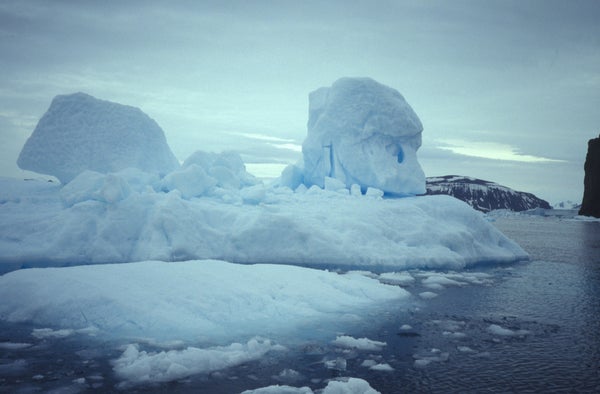
An ice sheet in West Antarctica is breaking from the inside out.
The significant new findings published yesterday in Geophysical Research Letters show that the ocean is melting the interior of the Pine Island Glacier, which is about the size of Texas. The crack seems to be accelerating, said Ian Howat, associate professor of earth sciences at Ohio State University and the study’s lead author. The findings are the first confirmation of something glaciologists have long suspected was happening, he said.
“It’s showing a new weakness in the ice shelf, and it’s showing the weakness may be extending far up the glacier,” he said. “That’s the alarming thing from our standpoint.”
On supporting science journalism
If you're enjoying this article, consider supporting our award-winning journalism by subscribing. By purchasing a subscription you are helping to ensure the future of impactful stories about the discoveries and ideas shaping our world today.
Higher ocean temperatures are causing the ice to shrink at an accelerating rate, and it’s eroding the ice fringing the continent. That, in turn, opens the ice sheet to further contact with warmer ocean water and increases the amount of ice running into the ocean, the researchers found.
“More importantly, it gives us a mechanism for even faster retreat in the future. Before, we used to have a slow retreat at the edges of the ice shelf,” Howat said. "The ocean had to nibble away at it on the edges. This allows the ice shelf to break apart way further inland from the inside out."
This latest retreat is particularly noteworthy because it’s farther inland than anything scientists have previously observed, he said. It also shows that the region could be more vulnerable than previously thought.
If Antarctica were not covered in ice, it would be a series of islands. That means much of the ice in the region is already under constant pressure from the ocean, as its movements dislodge the ice that covers the area between the land masses. Cracking is more likely to occur in the valleys located on the ice sheet, where the ocean is in closer contact with the ice, researchers found.
The currents off Antarctica are warmer and carry saltier water that encourages melting. The sea temperature is about 5 degrees Celsius, which is far warmer than the average surface temperature of minus 20 C. That causes a twofold vulnerability for the ice, because some of it is located underwater and because it is exposed to the warm sea around it.
Similar rifts have already been observed in Greenland, as the Arctic warms and ocean water flows along the bedrock, causing the ice to melt. The Pine Island Glacier and a similar-sized neighboring glacier are unique because they block ice flows from reaching the sea. That’s enough to keep about 10 percent of the ice sheet from toppling into the warmer water.
‘Significant collapse’ possible
A separate study published last week in Nature suggests that the melting of the Pine Island Glacier started in the 1940s, likely as a result of El Niño activity. Scientists obtained sediment cores from beneath the glacier to show that a cavity started forming before the mid-1940s. Warmer seawater flowed into the space and caused the glacier to lift off the sea-floor ridge that held it in place.
The thinning of the glacier shows that it is responding to shifts in sea temperatures that occur elsewhere in the world, even in the Pacific, researchers found. Once the melting begins, it can continue for decades, they said.
Understanding what caused the changes to the Pine Island Glacier and how long they could continue is important, said David Vaughan, director of science at British Antarctic Survey and a co-author of the study published in Nature.
“Ice loss from this part of West Antarctica is already making a very significant contribution to global sea-level rise, and is actually one of the largest uncertainties in global sea-level predictions,” he said.
The melting in Antarctica has a direct result on coastal cities across the globe. Imagine Antarctica as a dam, holding back ice instead of water, Howat said. It holds about half of the world’s fresh water. The spillways at the top of the dam are now open, increasing in volume and draining the reservoir. That increase will be felt as the sea levels rise and cities are inundated by increased flooding.
Scientists used satellite imagery to observe how the rift, located 20 miles inland, formed in 2013. Within two years, the rift had broken through the ice and caused a 225-square-mile iceberg to break off the glacier in the summer of 2015.
Howat said the rift is further evidence that it’s not a matter of if, but when the larger West Antarctic Ice Sheet will melt. It adds “to the probability that we may see significant collapse of West Antarctica in our lifetimes,” he said.
Reprinted from ClimateWire with permission from E&E News. E&E provides daily coverage of essential energy and environmental news at www.eenews.net.