
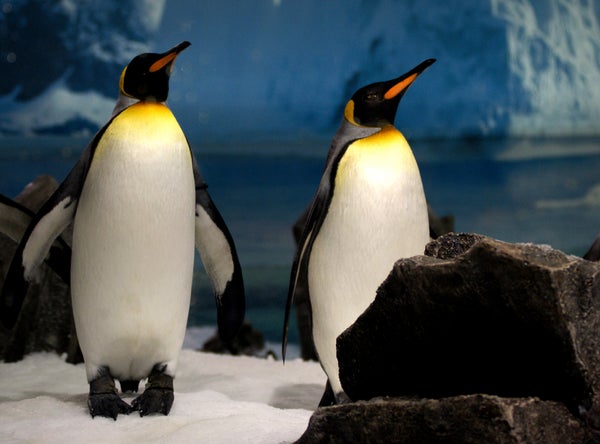
One of Antarctica's most iconic inhabitants, the stately king penguin, may be forced to find new places to live before the end of the century—or become the next victim of climate change.
King penguins make for a striking sight on the islands around Antarctica, with their tall, black-and-white tuxedoed bodies—second only in size to the emperor penguin—and bright yellow markings on their heads and chests. But sustained high levels of greenhouse gas emissions could drive the penguin's food sources farther and farther south over the next few decades, new research suggests, prompting the birds to follow suit. According to the new study, published yesterday in Nature Climate Change, 70 percent of the king penguin population will have to move or starve before the end of the century if carbon emissions don't start to drop.
What's even more worrying: King penguins can't live just anywhere.
On supporting science journalism
If you're enjoying this article, consider supporting our award-winning journalism by subscribing. By purchasing a subscription you are helping to ensure the future of impactful stories about the discoveries and ideas shaping our world today.
King penguins can only safely breed on ice- and predator-free islands in the Southern Ocean, the researchers note. Furthermore, the islands must be within a reasonable swimming distance from the nearest food supply—no farther than about 400 miles round trip—and the surrounding area must contain minimal levels of sea ice so the birds have access to the open water.
As the Antarctic continues to warm, some islands may become less hospitable to the birds due to changes in their preferred feeding grounds.
King penguins typically forage in a specific region of the Southern Ocean known as the Antarctic polar front, a kind of mixing zone where the cold, deep waters in the south meet the milder waters moving down from the north, attracting an abundance of fish and krill. As the Antarctic warms, though, this region may start to move farther south, taking its tasty food supply with it.
That means some of the islands the king penguins currently call home may eventually be too far for the penguins to access their foraging grounds. At the same time, though, warmer conditions and melting ice may mean some islands farther south could open up as potential habitats.
To investigate the penguins' fate, the researchers employed a special model to simulate the species' response to changes in the environment. It suggests that under a business-as-usual climate trajectory, in which greenhouse gas emissions remain high through the end of the century, the two most heavily populated islands—the Crozet and Prince Edward archipelagos, which currently house about half the current king penguin population—would become completely inhospitable to the birds. An additional 20 percent of the population, spread out across other islands in the Southern Ocean, would find its habitats "strongly altered," the researchers write, and would probably also have to move.
The research provides some room for optimism: A few other islands may become more favorable to the penguins in the future, expanding their potential habitat. But the researchers also warn that their findings are likely to be on the conservative side. The study does not account for a variety of other possible negative climate impacts, including ocean acidification, sea-level rise or changes in certain ocean circulation patterns, all of which could curtail the penguins' food sources or living spaces even further.
That means the greatest hope for the penguins is strong climate mitigation, the researchers suggest. When they tested a different climate scenario, assuming significant reductions in greenhouse gases through the end of the century—enough to keep global temperatures within the targeted 2-degree Celsius climate threshold—they found that most of the population would likely remain undisturbed.
Strong action now, the researchers write, "may still have a positive outcome for the Southern Ocean biodiversity."
Reprinted from Climatewire with permission from E&E News. E&E provides daily coverage of essential energy and environmental news at www.eenews.net.