
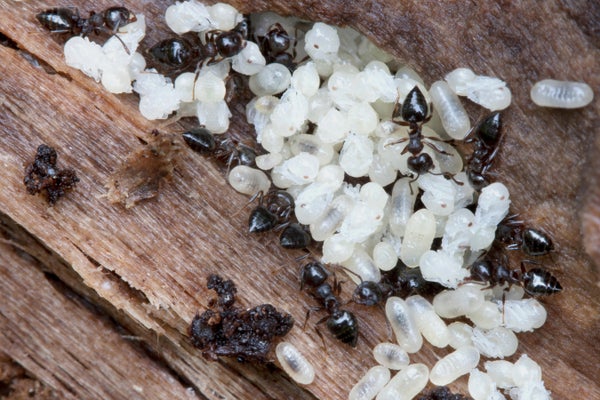
For the first time, researchers have observed ants secreting a milk-like fluid that nourishes others in the colony.
The research, published in Nature on 30 November, reveals that as pupae—an otherwise inactive developmental stage—ants produce a nutrient-rich fluid that is consumed by both adults and larvae.
Newly hatched larvae depend on this fluid to grow and survive, akin to how mammalian newborns depend on milk. If the ant adults and larvae do not consume the fluid, it builds up and becomes contaminated with fungi, which kill the pupae.
On supporting science journalism
If you're enjoying this article, consider supporting our award-winning journalism by subscribing. By purchasing a subscription you are helping to ensure the future of impactful stories about the discoveries and ideas shaping our world today.
“We identified a mechanism that unites the colony, binding ants across developmental stages—adults, larvae and pupae—into a coherent entity, the superorganism,” says co-author Orli Snir, a biologist at the Rockefeller University in New York City.
“It is really surprising that nobody else noticed this before,” says Patrizia d’Ettorre, an ethologist at Sorbonne Paris North University, France. “The pupae were considered useless [because] they are immobile, they spin a cocoon around them in some species, they don’t eat, they’re just moved around by the [ant] workers, so they [wouldn’t] contribute anything to ant society. But this paper shows that this is not true.”
Snir and her colleagues made the discovery by observing clonal raider ants (Ooceraea biroi) kept in isolation at different stages of their life cycle, to investigate what makes ant colonies so integrated.
While observing isolated ant pupae, the researchers were surprised to see droplets of a fluid appearing on their abdominal tips. When this fluid built up, the pupae drowned in it, but they survived when it was removed.
By injecting blue food dye into the pupae and tracing where it ended up, the researchers showed that adult ants drink the fluid as it is secreted, and also help their larvae to drink it by carrying them to the pupae. This stops the fluid accumulating. “The adults are doing parental care as they’re cleaning the pupae, taking the larvae and placing them on the pupae to feed,” says Snir.
The team tested the molecular composition of the fluid and identified 185 proteins that were specific to it, as well as more than 100 metabolites such as amino acids, sugars and vitamins. The compounds identified suggest that the fluid is derived from moulting fluids, which are produced when the larvae shed their outer cuticle as they develop into pupae. “It’s an opportunistic recycling that the ants are doing inside the colony … and a metabolic division of labour,” says Adria LeBoeuf, a biologist at the University of Fribourg, Switzerland.
Evolutionary role
The researchers also detected pupal ‘milk’ in species from each of the five biggest ant subfamilies, suggesting that it could play a part in the evolution of ant social structures. “It’s something that has evolved either shortly after ants became eusocial or maybe even before ants becoming social,” says co-author Daniel Kronauer, a biologist at the Rockefeller University.
The team now wants to study effects that pupal secretions might have on the adults and larvae in terms of behaviour and physiology. “Whether larvae [develop] into queen or worker might be modulated by how much access they have to this fluid,” says Kronauer.
Karsten Schönrogge, an ecologist at the UK Centre for Ecology & Hydrology in Wallingford, would like to see research on “whether the secretion of the pupae is also useful in the transfer of intestinal microbial communities that helps ants to digest food”.
This article is reproduced with permission and was first published on November 30 2022.