
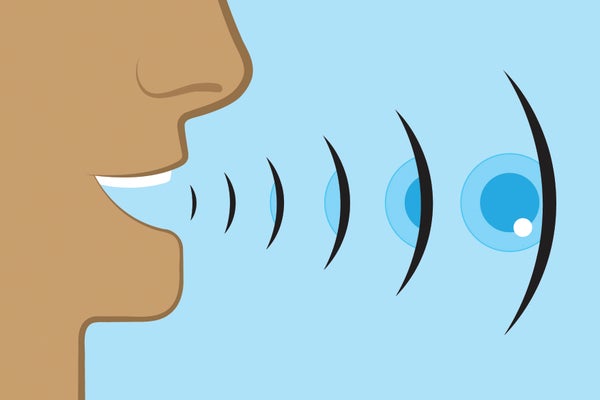
Human echolocation has at times allowed people to ride bikes or play basketball despite being completely blind from a very young age. These echolocators typically perceive their environment by clicking sharply with their tongues and listening to differences in the sounds reflected off objects.
Brain-imaging studies reveal that expert echolocators display responses to sound in their brain’s primary visual region, and researchers have speculated that long-term input deprivation could lead to visual regions being repurposed. “There’s been this strong tradition to think of the blind brain as different, that it’s necessary to have gone through that sensory loss to have this neuroplasticity,” says Lore Thaler, a neuroscientist at Durham University in England.
Thaler co-led a 2021 study showing that both blind and sighted people could learn echolocation with just 10 weeks of training. For more recent work in the journal Cerebral Cortex, she and her colleagues examined the brain changes underlying these abilities. After training, both blind and sighted people displayed responses to echoes in their visual cortex, a finding that challenges the belief that primary sensory regions are wholly sense-specific.
On supporting science journalism
If you're enjoying this article, consider supporting our award-winning journalism by subscribing. By purchasing a subscription you are helping to ensure the future of impactful stories about the discoveries and ideas shaping our world today.
The researchers trained 14 sighted and 12 blind people for between two and three hours twice a week over 10 weeks. They started by teaching participants to produce mouth clicks, then trained them on three tasks. The first two involved judging the size or orientation of objects. The third involved navigating virtual mazes, which participants moved through with the help of simulated click-plus-echo sounds tied to their positions.
Both groups improved on all the tasks. “This study adds a significant contribution to a growing body of evidence that this is a trainable, nonexotic skill that’s available to both blind and sighted people,” says Santani Teng, a psychologist at the Smith-Kettlewell Eye Research Institute in San Francisco, who studies echolocation and braille.
During brain scans before and after training, participants also performed a task that involved recognizing mazes, with and without click echoes. After training, both groups showed increased auditory cortex activation in response to sound in general, as well as higher gray matter density in auditory areas.
Most surprisingly, after training, both blind and sighted participants also showed visual cortex activation in response to audible echoes. “We weren’t sure if we would get this result in sighted people, so it was really rewarding to see it,” Thaler says. She suspects that rather than just processing visual data, this brain area takes in information from varied senses that aid spatial understanding.
Three months after the 2021 study, a follow-up survey found that 83 percent of blind participants who had learned echolocation reported improvements in independence and well-being. The researchers are working on disseminating the training more widely, Thaler says: “It’s a powerful sensory tool for people with vision impairments.”