
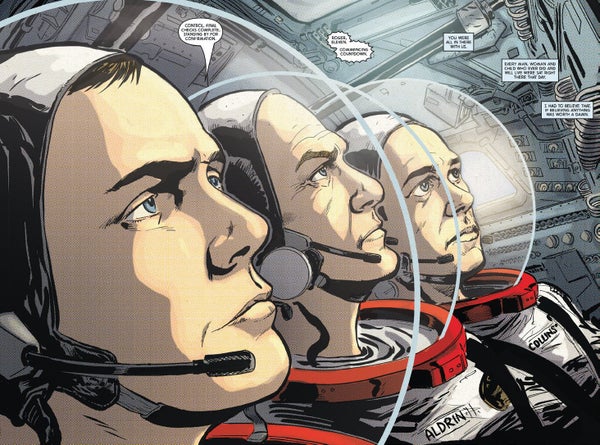
Apollo
by Matt Fitch, Chris Baker and Mike Collins.
SelfMadeHero, 2018 ($24.99)
The world waited anxiously during late July of 1969 for news of the first footsteps on the moon. Wives of the astronauts paced, President Richard Nixon in the White House mused on how the success or failure of the mission would play politically, and soldiers in the jungles of Vietnam compared themselves to the heroes in space. Writers Fitch and Baker teamed up with illustrator Collins (no relation to the Michael Collins, who flew with Neil Armstrong and Buzz Aldrin on the mission) to create a graphic novel of the suspense-filled story. They convey surprising depth and emotion, as well as rich historical details of the era. The book explores the political tension around the space program at the time, the nerve-wracking anxiety experienced by the families of the crew, and the heart-stopping moments of the mission that proved to be such a milestone.
How to Change Your Mind: What the New Science of Psychedelics Teaches Us about Consciousness, Dying, Addiction, Depression, and Transcendence
by Michael Pollan.
Penguin Press, 2018 ($28)
On supporting science journalism
If you're enjoying this article, consider supporting our award-winning journalism by subscribing. By purchasing a subscription you are helping to ensure the future of impactful stories about the discoveries and ideas shaping our world today.
A Swiss chemist took the first documented acid trip in April 1943. The researcher, Albert Hofmann, was synthesizing molecules from ergot—a fungus that commonly infects grains used for bread. He accidentally absorbed one of these compounds—lysergic acid diethylamide, LSD-25 for short—perhaps through his skin while working with it. Since then, psychedelic drugs have had a reputation mostly as a dangerous hippie pastime. Science writer Pollan examines what these chemicals might teach us about consciousness and the brain and even gives them a try himself—taking LSD in a yurt in an unnamed American mountain range under the guidance of a Bavarian ex-con.
Who Cares about Particle Physics? Making Sense of the Higgs Boson, the Large Hadron Collider and CERN
by Pauline Gagnon.
Oxford University Press, 2018 (paperbound, $19.95)
Many people have heard the term “Higgs boson” and perhaps recall the hubbub when this particle was discovered in 2012. But how many really know what it is? Anyone wishing to bone up on particle physics would benefit from physicist Gagnon's book, which profiles the tiniest stuff in the universe. In addition to offering one of the most thorough yet accessible explanations of the Higgs boson, Gagnon—a former member of the ATLAS experiment at the Large Hadron Collider—gives an insider's account of the powerful accelerator where atoms crash together to create exotic particles. If theorists' hunches are borne out in ongoing experiments, she writes, “We are most likely on the verge of a huge scientific revolution.” —Clara Moskowitz
She Has Her Mother’s Laugh: The Powers, Perversions, and Potential of Heredity
by Carl Zimmer.
Dutton, 2018 ($30)
Until the 19th-century revelation of heredity from Austrian monk Gregor Mendel, humankind mostly toyed with “genetics” through trial and error and guesswork. Since Mendel, scientists have figured out not only that sequences of DNA called genes encode traits such as eye color and height but that slight mistakes in those sequences can cause debilitating maladies. Science writer Zimmer threads together many intriguing narratives—each a story about how researchers tackled, and often misunderstood, heredity. From the horrors of eugenics to the discovery of a bacterial tool (the CRISPR/Cas9 complex) that snips away problematic DNA, he shows how our advancing knowledge of genetics continues to shape society and our very beings. —Yasemin Saplakoglu