
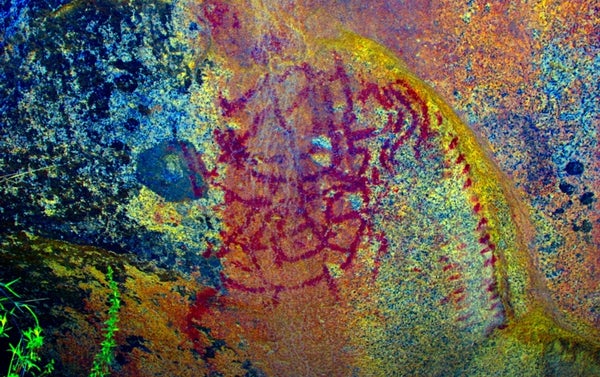
For the past five years archaeologists have been tracking a series of rock art findings in north-central Chile’s Limari Valley. The experts involved say finding traces of the visual language used by the area’s inhabitants has been difficult; the paintings are highly deteriorated and cannot be identified with the naked eye. But with the help of digital technology including high-resolution cameras, tablets and specialized software, researchers have been able to detect the presence of paintings that time and erosion have almost erased.
The team of Chilean anthropologists and archaeologists found more than 150 paintings. They were probably created by hunter-gatherers between 2000 BC and 500 AD in the Coquimbo Region, an area south of the Atacama Desert that extends to about 400 kilometers north of the Chilean capital, Santiago.
During the study photos were taken of the target rocks and the resulting images were analyzed with DStretch software, which detects colors and patterns difficult to observe with the naked eye. "This program has algorithms predefined for working with rock art," says study leader Andres Troncoso, an archaeologist at the University of Chile.
On supporting science journalism
If you're enjoying this article, consider supporting our award-winning journalism by subscribing. By purchasing a subscription you are helping to ensure the future of impactful stories about the discoveries and ideas shaping our world today.
"These new technologies are allowing us to account for a universe of representations that were poorly known because the conservation status of these paintings is bad," says Marcela Sepulveda, an archaeologist at the University of Tarapaca, who has done studies on rock art in northern Chile.
From the captured images, researchers singled out those from stones still bearing some sort of noticeable archaeological evidence such as pigment. They further considered designs consistent with rock art that was already known to be from the area and that had undoubtedly been produced by humans.
The newly discovered paintings consist mainly of lines, circles and squares of different colors. It is believed that the pigments were derived from locally available minerals, probably combined with animal fat. It remains unclear what tools were used to create their art. According to Troncoso the painters could have used brushes, fingers or a combination of both. But there is more certainty about the materials they used for each color: Red was made with hematite, green with copper, yellow with goethite and black with coal.
"We were lucky that the black paintings were made with coal," Troncoso says. Thanks to that, researchers were able to perform radiocarbon analysis to date the paintings more accurately. "If you look at the archaeological literature globally, there are very few absolute dates for rock art," he explains, emphasizing the importance of this finding.
The artists and their sense of belonging
The study results, published in the Journal of Anthropological Archaeology, suggest that the paintings belong to different groups of pre-Hispanic inhabitants of the Limari area: people from the coastal area and others from the mountains. While the art produced by both communities has similarities—such as the absence of animal and human figures—the study concludes that the design composition and use of color is different in both groups. "Down (on the coast) there are parallel lines that are not present up (in the mountains)," Troncoso says, adding that those who lived on the mountains also displayed art with a greater variety of colors.
Determining the meaning of rock art is a very complex task. This study suggests that the Chilean paintings helped generate a sense of identity and belonging within communities. "Ultimately it comes down to marking which is my territory and which is not my territory," Troncoso says. "It's like saying, 'Those of us who occupy this territory are in the same group and we paint this way.'" Archaeologist Marcos Biskupovic agrees. Marcos, with the Archaeological Museum of La Serena, who was not involved in this study, says that these paintings "can be badges for a particular social identity."
The need to mark territory might have emerged from social transformations such as population growth. “The large number of people made it necessary to divide the use of space and social units," Troncoso says. "It seems like a valid interpretation, to situate these images within the population growth context," Sepulveda adds, explaining that other regions in Chile have seen similar processes.
Several questions about the findings remain unanswered, including how this rock art evolved over 2,500 years and whether there were other kinds of social transformations in these communities of hunter-gatherers. There is also the matter of what might have been going on in the valleys adjacent to the study area, which covers 115 square kilometers, and how far these communities and their paintings reached into neighboring areas. "Outlining these aspects would help us delineate the socio-political reality of these hunter-gatherers," Troncoso says.
For now, the discovery of the paintings provides at least a little more of a glimpse into the visual language used by the pre-Hispanic inhabitants in this part of Latin America. "This research has allowed us to organize pieces of information that until now were widely dispersed, and to discover new sites that were previously unknown," Sepulveda says.