
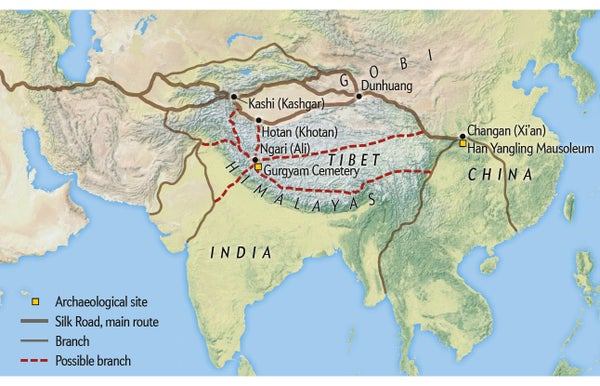
Famous for facilitating an incredible exchange of culture and goods between the East and the West, the ancient Silk Road is thought to have meandered across long horizontal distances in mountain foothills and the lowlands of the Gobi Desert. But new archaeological evidence hidden in a lofty tomb reveals that it also ventured into the high altitudes of Tibet—a previously unknown arm of the trade route.
Discovered in 2005 by monks, the 1,800-year-old tomb sits 4.3 kilometers above sea level in the Ngari district of Tibet. When excavations began in 2012, the research team examining the site was surprised to find a large number of quintessential Chinese goods inside. The haul lends itself to the idea that merchants were traveling from China to Tibet along a branch of the Silk Road that had been lost to history.
“The findings are astonishing,” says Houyuan Lu, an archaeobotanist at the Chinese Academy of Sciences' Institute of Geology and Geophysics in Beijing. Among other artifacts, archaeologists unearthed exquisite pieces of silk with woven Chinese characters wang hou (meaning “king” and “princes”), a mask made of pure gold, and ceramic and bronze vessels.
On supporting science journalism
If you're enjoying this article, consider supporting our award-winning journalism by subscribing. By purchasing a subscription you are helping to ensure the future of impactful stories about the discoveries and ideas shaping our world today.
They also were taken aback by what looked like tea buds. The earliest documentation of tea in Tibet dates to the seventh century A.D., but these buds would be 400 to 500 years older. To confirm the identification, Lu and his colleagues analyzed the chemical components of the samples and detected ample amounts of caffeine and theanine, a type of amino acid abundant in tea. Moreover, the chemical fingerprints of the tea residues were similar to those of tea found in the tomb of a Chinese emperor of the Han Dynasty dated to 2,100 years ago, and both could be traced to tea varieties grown in Yunnan in southern China. “This strongly suggests that the tea [found in the Tibetan tomb] came from China,” Lu says. The findings were recently published in Scientific Reports.
Such early contacts between Tibet and China “point to a high-altitude component of the Silk Road in Tibet that has been largely neglected,” says Martin Jones, an archaeobotanist at the University of Cambridge. The evidence contributes to the emerging picture that the Silk Road—which the Ottoman Empire closed off in the 15th century—was a highly three-dimensional network that not only traversed vast linear distances but also scaled tall mountains.
Other studies, too, have documented signs of trade along mountain trails in Asia from around 3000 B.C.—routes now known as the Inner Asia Mountain Corridors. “This suggests that mountains are not barriers,” says Rowan Flad, an archaeologist at Harvard University. “They can be effective conduits for the exchange of cultures, ideas and technologies.”
