
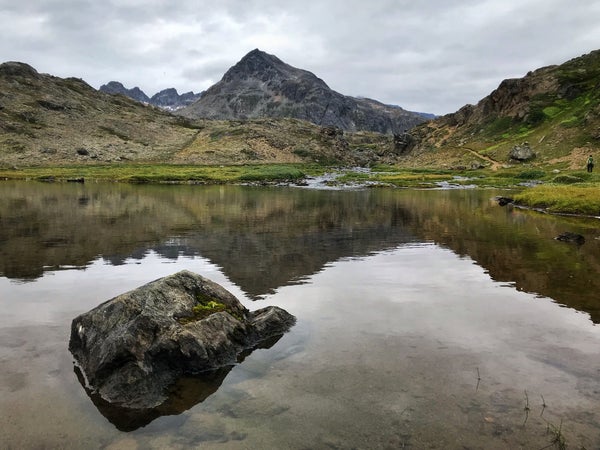
The rapidly warming Arctic is no stranger to loss. Climate change is gradually claiming some of its most iconic features, from melting glaciers in Greenland to shrinking sea ice in the ocean.
But some casualties may be more surprising than others.
Research suggests that small lakes and ponds across the Arctic tundra are also steadily disappearing. Hundreds, in fact, have vanished from the landscape in the last few decades alone. Some of them may have been there for hundreds of years, scientists say.
On supporting science journalism
If you're enjoying this article, consider supporting our award-winning journalism by subscribing. By purchasing a subscription you are helping to ensure the future of impactful stories about the discoveries and ideas shaping our world today.
It may seem counterintuitive on a landscape where frozen ice and snow are rapidly turning into liquid water. Scientists had once speculated that climate change may actually increase the number of lakes across the tundra, as thawing permafrost—a layer of frozen soil common in the Arctic—causes water to pool on the landscape.
But surveys increasingly suggest the opposite is happening.
New research, presented last week at the fall meeting of the American Geophysical Union in Washington, D.C., found that hundreds of tundra ponds have vanished from a single corner of western Greenland over the last 50 years. Satellite imagery shows that more than 400 ponds near the town of Kangerlussuaq, out of a survey of more than 2,000, have disappeared since 1969. Others have persisted but are smaller than they once were.
A variety of factors may be at play, according to lead researcher Rebecca Finger of Dartmouth College. In part, a warming climate may be causing more water to evaporate in some regions. And, perhaps unexpectedly, thawing permafrost likely also plays a large role—just not in the way scientists once thought it might.
As the soil warms and softens, some small lakes may simply drain right into the groundwater. Thawing permafrost may also release certain nutrients into the soil as it warms up, increasing the growth of vegetation. As plants spring up on the landscape, they can invade small ponds and eventually overtake them entirely, said Christian Andresen, a postdoctoral researcher at the University of Wisconsin.
“This enrichment of nutrients can really trigger the density and cover of these aquatic grasses,” he told E&E News.
Andresen was not involved with the new research but has conducted Arctic surveys of his own and found a similar effect in northern Alaska. A 2015 paper, which he co-authored with Vanessa Lougheed of the University of Texas, El Paso, surveyed 2,800 ponds on the Barrow Peninsula and found that nearly 500 have disappeared since the 1940s, while others have shrunk in size.
Multiple other studies have documented similar declines in other places across the Arctic tundra, suggesting it’s a widespread trend.
A 2011 paper, broadly focused on northern Canada, analyzed more than 76,000 bodies of water and found that their total area declined by more than 2,500 square miles between the years 2000 and 2009 alone.
And a 2005 paper surveyed 10,000 large lakes in Siberia, all at least 40 hectares (or about 100 acres) in size, and found that 125 of them disappeared altogether between 1973 and 1998, while more than a thousand shrank below the 40-hectare threshold. Total lake surface area declined by about 6 percent.
In these studies, as in the new research, the researchers largely pointed to thawing permafrost as the culprit. In general, small ponds tend to be more vulnera“le than larger lakes. Finger’s research, for instance, found that almost all the pools that disappeared entirely were less than 1 hectare, or about 2 ½ acres, in area. Still, the earlier Siberia research demonstrates that large lakes are by no means completely safe.
An emerging cause for concern
Vanishing lakes—even small ones—could spell trouble, experts say. These bodies of water are important fixtures of the Arctic ecosystem.
“For animals, it really matters,” Finger noted.
Lakes and ponds are important habitat for many species, particularly migratory birds, as well as water sources for other animals like caribou. They’re sometimes home to threatened or endangered species, Andresen added, like the spectacled eider, an Arctic sea duck that prefers to nest near shallow ponds or lakes.
On top of this, shrinking ponds may release climate-warming methane into the atmosphere if they’re overtaken by vegetation. On a large enough scale, this could make them part of a vicious feedback cycle—methane worsens global warming, which causes more thawing, which causes more lakes to disappear.
It’s an issue Andresen has also investigated. In a 2017 study, he and colleagues from the University of Texas, El Paso, looked at the changes in methane emissions from wetlands in Barrow, Alaska, as the ground has thawed and filled up with vegetation over the last few decades. In 40 years, they found the plant-related methane flux increased by 60 percent.
On an Arcticwide scale, it’s still unclear whether vanishing lakes are likely to have a significant effect on carbon emissions. That kind of research may be “the next part of the story on what’s happening in terms of carbon fluxes from the shrinking ponds,” Andresen said.
In a broader sense, the vanishing lakes may also be a warning sign of other changes yet to come as the climate continues to warm. Thawing permafrost, in and of itself, is also known to release large quantities of methane and carbon dioxide, which scientists worry may become a growing contributor to climate change.
And if the Arctic continues to dry out, the landscape may also change in other ways—for instance, by becoming more prone to wildfires.
Just last year, the final year of Finger’s study period, “there was actually a fire that broke out on the tundra of West Greenland which was highly unusual,” she said in an email.
Reprinted from Climatewire with permission from E&E News. E&E provides daily coverage of essential energy and environmental news at www.eenews.net.