
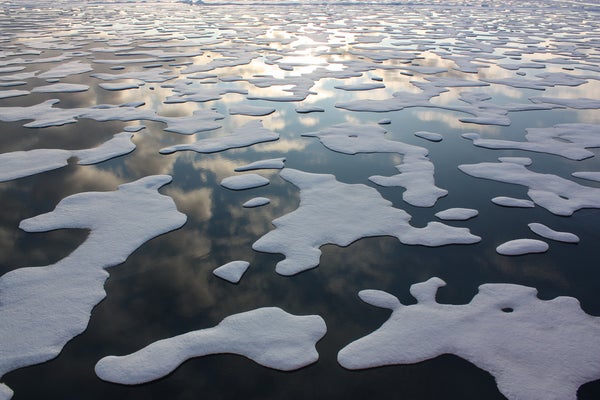
The Arctic Ocean is freezing up at a slower pace than ever before, with the extent of sea ice at a lower level this fall than in all previous years, the National Snow and Ice Data Center reported this week.
The North Pole averaged 2.5 million square miles of ice in October. That’s 154,400 square miles less than the previous record set during October 2007.
Scientists said that as of early November, the ice levels remained especially low in Alaska’s Beaufort and Chukchi seas and Russia’s East Siberian and Kara seas.
On supporting science journalism
If you're enjoying this article, consider supporting our award-winning journalism by subscribing. By purchasing a subscription you are helping to ensure the future of impactful stories about the discoveries and ideas shaping our world today.
Julienne Stroeve, senior research scientist at the National Snow and Ice Data Center, said ice formation slowed this year because of warmer-than-usual air and surface water temperatures north of Alaska and Russia, caused in part by this summer’s low sea ice levels (ClimateWire, Sept. 16).
“This summer saw the lowest maximum ice extent on record,” Stroeve explained. “We had record low sea ice conditions all the way through June. Those areas got more solar heating earlier in the melt season than they may otherwise have had. So that helped to absorb more of the sun’s energy through the summer.”
Stroeve said the October sea ice levels are just the latest evidence of warming conditions in the Arctic.
“One of the things we do know about the Arctic is that it’s been warmer than average in every month lately,” she said. “You have this background warming from greenhouse gases, and then you have natural climate variability, and they’re both acting on the system at the same time.”
The warming temperatures are affecting conditions in Alaska’s coastal communities. The National Weather Service said that Barrow, Alaska, located along the Beaufort Sea, had an average October daily high temperature above freezing for the first time on record. That monthly average exceeded the previous warmest temperature by more than 2 degrees Fahrenheit.
Three other coastal Alaska communities also posted record-warm October averages—Kotzebue, which is on the Chukchi Sea, and Nome and St. Paul along the Bering Sea.
The warming is also taking a toll on the oldest and thickest ice in the Arctic, according to data from NASA’s Goddard Space Flight Center.
As the Arctic warms, the multiyear ice has thinned or melted away, leaving the Arctic sea ice cap more vulnerable to the warming ocean and atmosphere. The older, multiyear ice can grow up to 13 feet and have a life span of nine years or more. By contrast, first-year ice that grows during a single winter is generally at most 6 ½ feet thick.
“What we’ve seen over the years is that the older ice is disappearing,” said NASA sea ice researcher Walt Meier. “This older, thicker ice is like the bulwark of sea ice: A warm summer will melt all the young, thin ice away, but it can’t completely get rid of the older ice.
“But this older ice is becoming weaker because there’s less of it, and the remaining old ice is more broken up and thinner, so that bulwark is not as good as it used to be,” he said.
Reprinted from ClimateWire with permission from Environment & Energy Publishing, LLC. E&E provides daily coverage of essential energy and environmental news at www.eenews.net. Click here for the original story.