
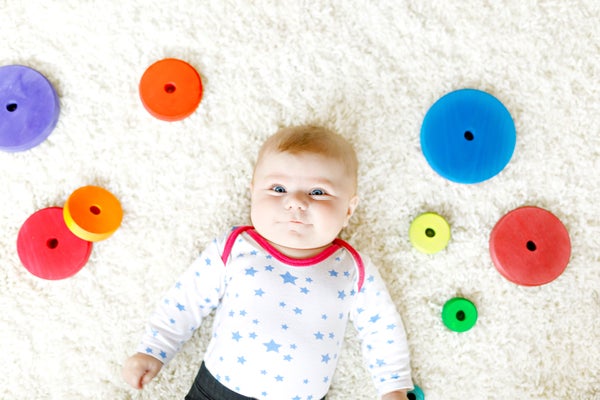
In English the sky is blue, and the grass is green. But in Vietnamese there is just one color category for both sky and grass: xanh. For decades cognitive scientists have pointed to such examples as evidence that language largely determines how we see color. But new research with four- to six-month-old infants indicates that long before we learn language, we see up to five basic categories of hue—a finding that suggests a stronger biological component to color perception than previously thought.
The study, published recently in the Proceedings of the National Academy of Sciences USA, tested the color-discrimination abilities of more than 170 British infants. Researchers at the University of Sussex in England measured how long babies spent gazing at color swatches, a metric known as looking time. First the team showed infants one swatch repeatedly until their looking time decreased—a sign they had grown bored with it. Then the researchers showed them a different swatch and noted their reaction. Longer looking times were interpreted to mean the babies considered the second swatch to be a new hue. Their cumulative responses showed that they distinguished among five colors: red, green, blue, purple and yellow.
The finding “suggests we're all working from the same template,” explains lead author Alice Skelton, a doctoral student at Sussex. “You come prepackaged to make [color] distinctions, but given your culture and language, certain distinctions may or may not be used.” For instance, infants learning Vietnamese most likely see green and blue, even if their native language does not use distinct words for the two colors.
On supporting science journalism
If you're enjoying this article, consider supporting our award-winning journalism by subscribing. By purchasing a subscription you are helping to ensure the future of impactful stories about the discoveries and ideas shaping our world today.
The study systematically probed infants' color perception, revealing how we perceive colors before we have the words to describe them, says Angela M. Brown, an experimental psychologist at the Ohio State University's College of Optometry, who was not involved with the new research. The results add a new wrinkle to the perennial nature-versus-nurture debate and the so-called Sapir-Whorf hypothesis—the idea that the way we see the world is shaped by language.
In future work, Skelton and her colleagues are interested in testing babies from other cultures. “The way language and culture interact is a really interesting question,” she says. “We don't yet know the exact mechanisms, but we do know how we start off.”