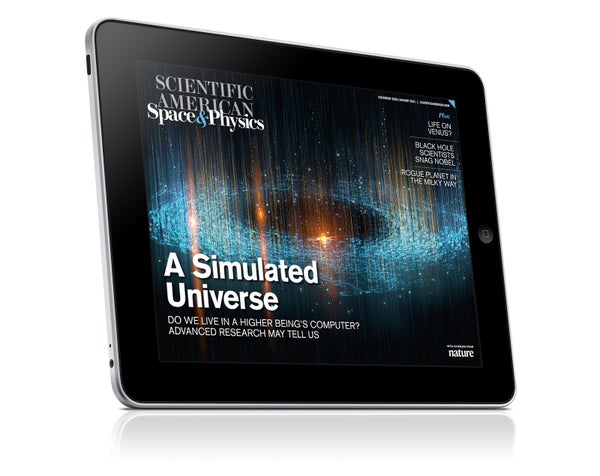
What if this life is just a computer simulation running on some intellectually superior alien’s console? Something about this idea is tantalizing to people (evidenced by the success of The Matrix films) and has special appeal for our readers. It’s hooked physicists, philosophers, computer scientists and engineers, too, as author Anil Ananthaswamy writes in this edition’s cover feature [“Do We Live in a Simulation? Chances Are about 50–50”]. What is it, exactly, that is so enticing about this possibility? The fear that we are mere puppets of a more advanced species? Or perhaps it’s the calm that comes from the idea that none of this is real anyway. Examining the nature of our own reality, indeed whether we have a reality, is the most “meta” branch of physics.
In more satisfying endeavors, journalist Daniel Garisto reviews the long history of the search for black holes, whose champions were awarded this year’s Nobel Prize in Physics [“Nobel Prize Work Took Black Holes from Fantasy to Fact”]. One recipient, physicist Andrea Ghez, pushed her fellow astronomers and technicians tirelessly, despite doubt from the field, as her colleague Hilton Lewis describes in this issue’s opinion section [“How Andrea Ghez Won the Nobel for an Experiment Nobody Thought Would Work”]. Sometimes we have to fight for the realities we believe in.
Subscribe to Support Independent Journalism
Great science journalism requires human expertise, time, effort and creativity. And it costs money. That’s why I and the journalists here at Scientific American hope you’ll join our community.
When you subscribe, you are supporting staff and freelance journalists who are passionate about telling science stories that are true, important and compelling. Our editors and reporters are often experts in their fields, which means they understand the nuances of big discoveries and can untangle the breakthroughs from the hype. With a subscription, you are also supporting rigorous fact-checking to ensure the words we publish are precise and accurate. And you’re supporting original illustrations, graphics and photos that bring you closer to an advanced laboratory, an ice sheet in Antarctica or a space mission in orbit. You’re helping us craft other types of high-quality journalism as well: Our newsletters are carefully written, edited and curated by staffers you have or will come to know and love. Our Science Quickly podcast is based on original reporting, collaboration with editors and scientists and exacting production.
Subscriptions keep this engine running so we can continue to deliver thoughtful, rigorous and independent science journalism to you. In an era of viral misinformation, this work is crucial. If you value what we do, I hope you’ll consider joining us as a subscriber
Thank you,
Jeanna Bryner, Editor in Chief, Scientific American