

Imagine if we could hop over to our nearest massive galaxy neighbor Andromeda and check out what our Milky Way looks like from the outside.
Or, want to know if the recently discovered Earth-like exoplanet is habitable? Send a probe over to check! The main challenge to space exploration has never been our imagination, or even our ability to come up with new technologies to make space flight possible, but the vastness of space.
On supporting science journalism
If you're enjoying this article, consider supporting our award-winning journalism by subscribing. By purchasing a subscription you are helping to ensure the future of impactful stories about the discoveries and ideas shaping our world today.
It took 9.5 years for the New Horizons spacecraft just to get to Pluto which is still within our solar system. The nearest star (after our Sun) is more than 26 trillion miles away! Wouldn’t it be convenient if the universe offered us a shortcut?
What Is a Wormhole?
Theoretical physicists have hypothesized the existence of such shortcuts through spacetime since the 1930s, originally calling them white holes and eventually Einstein-Rosen bridges. A white hole acts like the reverse of a black hole by emitting energy while not allowing anything to enter. (Black holes, of course, allow matter and energy to enter but, much like the Hotel California, once you enter, you can never leave.) Since the name “Einstein-Rosen bridges” is a bit dry, they became more commonly known as wormholes.
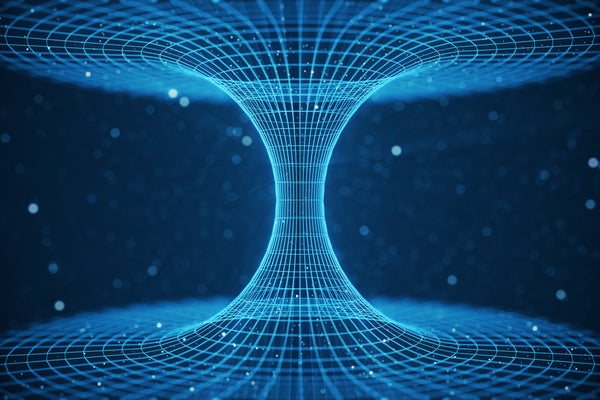
You can picture a wormhole as a kind of tunnel that connects two points in spacetime. That tunnel could be a straight chute or take a more winding path. If the wormhole is "traversable" it acts as a shortcut through spacetime, connecting two points that would otherwise be far apart. Wormholes could connect different spots within a single universe or they can connect different universes.
The most common way wormholes are depicted is to imagine you are holding a piece of paper that represents normal space. Think of traveling through space as traveling along the sheet of paper. Now mark a point at each end and bend the piece of paper in half, bringing those two points together but without letting them touch. If you were to travel in normal space (i.e. along the sheet of paper) the trip from one of your marks to the other would be longer than if there were a tunnel or a "wormhole" connecting the two points on the paper through the empty space between them.
Now the big question—do wormholes really exist?
»Continue reading “Are Wormholes Real?” on QuickAndDirtyTips.com