

The Arecibo Observatory in Puerto Rico remained offline today (Sept. 21) after Hurricane Maria battered the island on Wednesday, leaving a trail of destruction that included a total loss of power.
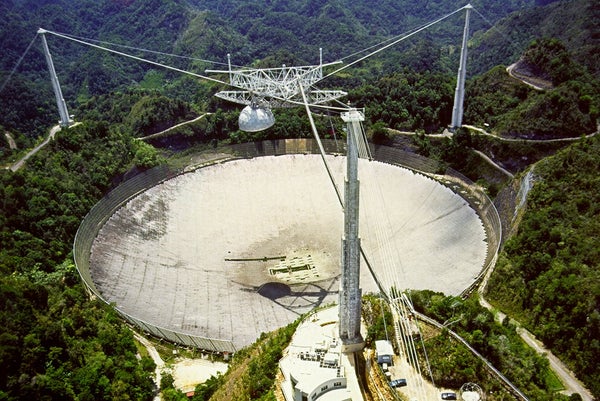
The Arecibo Observatory, in Puerto Rico's northwest, houses the world's second-largest radio telescope. While the facility has been closed all week for the hurricane, a handful of staff members had remained inside the observatory, waiting for the storm to pass.
"Most cell towers and all landlines are down," Aya Collins, a spokeswoman for the National Science Foundation (NSF), told Space.com in an email. With no power, phones or internet, the people of Puerto Rico have very limited means of communication with the outside world. "We haven't received any official communications from the Arecibo Observatory," Collins said. [In Photos: Hurricane Maria Seen from Space]
On supporting science journalism
If you're enjoying this article, consider supporting our award-winning journalism by subscribing. By purchasing a subscription you are helping to ensure the future of impactful stories about the discoveries and ideas shaping our world today.
In an update posted at noon EDT today (Sept. 21), officials with the Universities Space Research Association (USRA), which helps to operate the Arecibo Observatory, said they also have been unable to contact people at the facility.
However, the USRA update noted that "one observatory staff member located in the town of Arecibo contacted via short-wave radio reports that trees are down, power is out, houses damaged and roads impassable."
Staff who took shelter at the observatory were well-prepared for the treacherous storm, which made landfall as a Category 4 hurricane and engulfed the island with floods and heavy winds.
"We have no reason to believe that staff sheltered at Arecibo Observatory are in immediate danger since they have generators, well water and plenty of food," the USRA update states. "This is a rapidly changing situation, and we are trying to do the best we can to contact USRA employees and find out their status."
Collins said that as soon as roads are passable, a team will go to the observatory to check on the staff who sheltered there during the storm and start to survey the damage. But they will have to wait for water levels to drop first. "The river between Bayamon and Dorado (Rio Bucarabones, I believe), about 10 miles west of San Juan, has flooded the highways, and so the western part of the island (including Arecibo) is cut off until the water levels drop."
As of this morning, Collins said that "all roads are blocked or flooded," adding that "local authorities are saying it’ll take them three days just to get to Manatí, about halfway from San Juan to Arecibo."
Despite the long wait, the staff at the Arecibo Observatory should be able to manage until help arrives. "They have fuel to run the generators, a well for water, and enough food for week," Collins said.
And even though the roads are flooded across Puerto Rico, the giant radio telescope at Arecibo should be relatively dry. It is located more than 1,000 feet (300 meters) above sea level, and the dish does not accumulate rainwater because it is made out of a mesh-like material, Collins said. And just in case waters rise, Collins said "there is a sump-pump under the dish with its own diesel generator."
Before Maria hit Puerto Rico, Arecibo employees prepared the facility by "hurricane-proofing" buildings, tying down or stowing any movable equipment.
For now, we'll just have to wait and see how the Arecibo Observatory fared in the storm. You can find additional updates on Hurricane Maria here.
Email Hanneke Weitering at hweitering@space.com or follow her @hannekescience. Follow us @Spacedotcom, Facebook and Google+. Original article on Space.com.
Editor's Recommendations
Copyright 2017 SPACE.com, a Purch company. All rights reserved. This material may not be published, broadcast, rewritten or redistributed.