
By Ernest Scheyder and Terray Sylvester
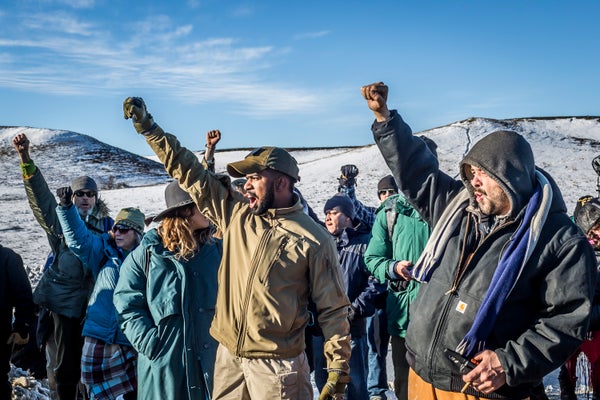
CANNON BALL, N.D. (Reuters) - Thousands of protesters in North Dakota celebrated after the federal government ruled against a controversial pipeline project on Sunday, even though many recognized that the fight is likely to continue into next year.
The U.S. Army Corps of Engineers said it rejected an application to allow the Dakota Access Pipeline to tunnel under Lake Oahe, a reservoir formed by a dam on the Missouri River.
On supporting science journalism
If you're enjoying this article, consider supporting our award-winning journalism by subscribing. By purchasing a subscription you are helping to ensure the future of impactful stories about the discoveries and ideas shaping our world today.
The decision came after months of protests from Native Americans and climate activists, who argued that the 1,172-mile (1,885-km) Dakota Access Pipeline would damage sacred lands and could contaminate the tribe's water source.
The mood has been upbeat since the rejection was announced on Sunday afternoon at the Oceti Sakowin camp in Cannon Ball, North Dakota. Activists were seen hugging and letting out war cries in response to the news.
Still, with the incoming administration of President-elect Donald Trump supportive of the project, activists worried a reversal of the decision could be in the offing.
"This is a temporary celebration. I think this is just a rest," said Charlotte Bad Cob, 30, from the Pine Ridge Reservation in South Dakota. "With a new government it could turn and we could be at it again."
The camp's numbers have swelled in recent days, as hundreds of U.S. veterans have flocked to North Dakota in support of the protesters. Some of those in a long line of traffic along Highway 1806 heading into the camp hollered and honked their horns after the news was announced.
The pipeline, owned by Texas-based Energy Transfer Partners LP, is complete except for a one-mile segment to run under Lake Oahe. That stretch required an easement from federal authorities.
The U.S. Army Corps of Engineers said it will analyze possible alternate routes, although any other route is also likely to cross the Missouri River.
FIGHT MAY BE A ‘LONG HAUL’
Standing Rock Chairman Dave Archambault II, in a statement, said he hoped ETP, North Dakota Governor Jack Dalrymple and Trump would respect the decision.
"When it comes to infrastructure development in Indian Country and with respect to treaty lands, we must strive to work together to reach decisions that reflect the multifaceted considerations of tribes," he said.
Trump has yet to react to Sunday's decision. He could direct authorities to approve the line, even if before he takes over from Democratic President Barack Obama on Jan. 20 federal authorities will be studying alternative routes.
Tom Goldtooth, a Lakota from Minnesota, and a co-founder of Indigenous Environmental Network, said he expects Trump to try to reverse the decision.
"I think we're going to be in this for the long haul. That's what my fear is," he said.
Energy Transfer said late Sunday they do not intend to reroute the line, calling the Obama Administration's decision a "political action."
In November, ETP moved equipment to the edge of the Missouri River to prepare for drilling, and later asked a federal court to disregard the Army Corps, and declare that the company could finish the line. That ruling is still pending.
Several veterans recently arrived in camp told Reuters they thought Sunday's decision, which came just as Oceti Sakowin has seen an influx of service members, was a tactic to convince protesters to leave.
"That drill is still on the drill pad. Until that's gone, this is not over," said Matthew Crane, 32, from Buffalo, who arrived with a contingent of veterans last week.