
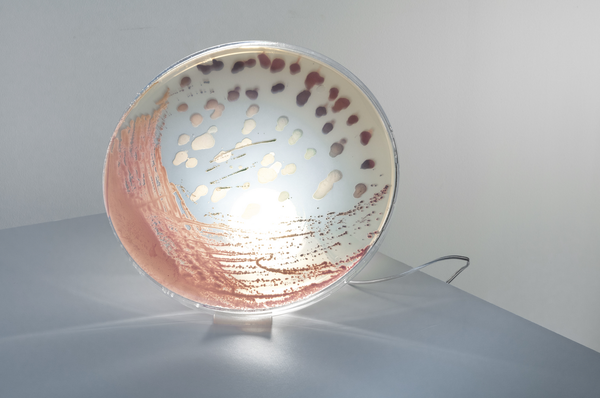
Most people think of bacteria as unseen disease carriers and simply want to wash their hands of them. But Stockholm-based industrial designer Jan Klingler is putting them in the spotlight with his colorful lamps. “Every living being and place has its own unique and personal microbiological fingerprint,” Klingler says. By capturing such signatures, he aims to bottle memories.
Customers who order one of Klingler’s lamps—which will be for sale soon—will get a kit with a sterile swab they can brush on a loved one, pet or object. (Klingler himself swabbed the subway station pillar where he met his partner.) The customer will send the sample back to Klingler, who will culture it in a petri dish.
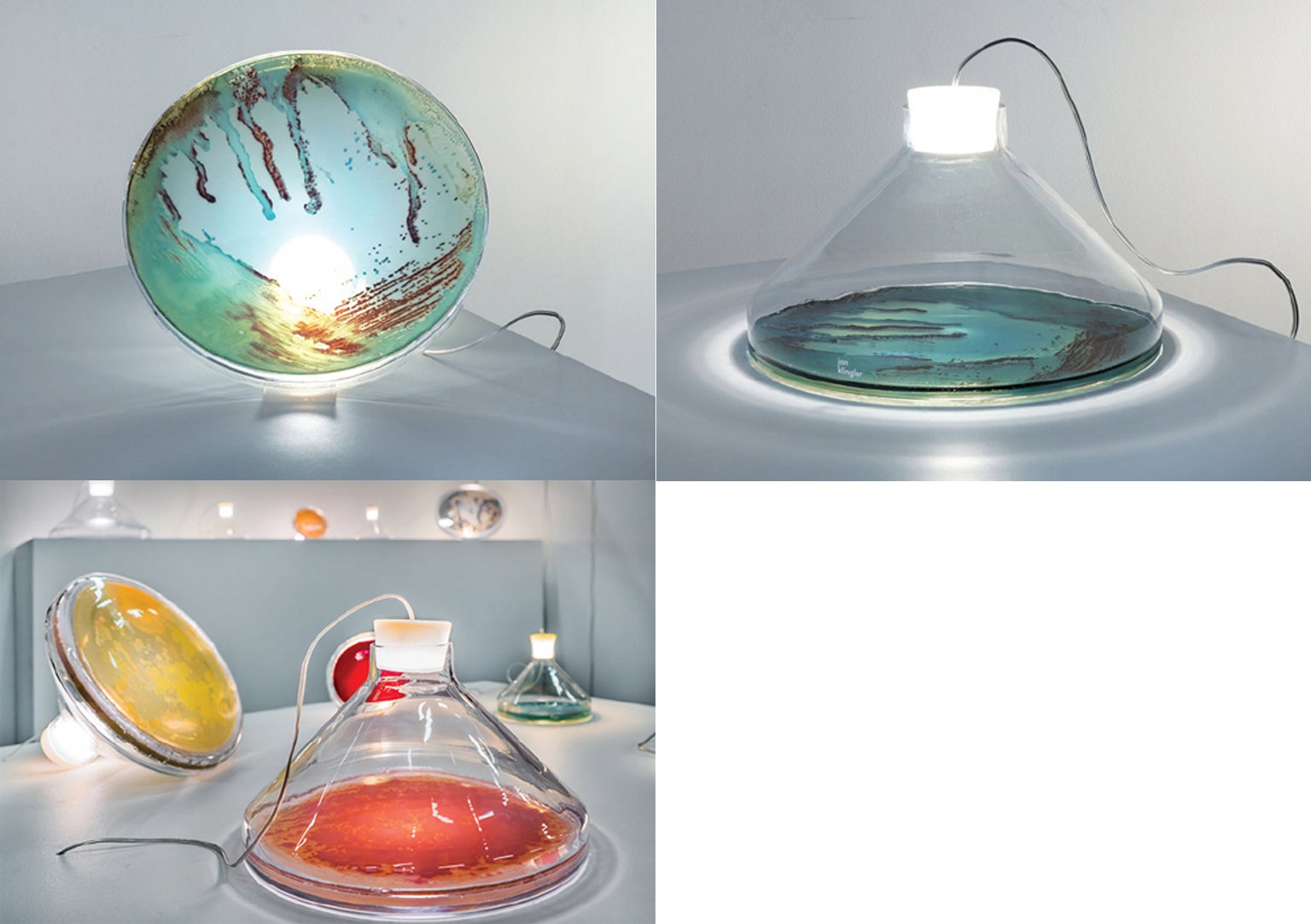
Colorful bacterial colonies— such as Serratia marcescens and Escherichia coli (top left and top right) and other species (bottom)—add flair to flasklike lamps. Credit: Sandy Haggart (top left and top right); Michal Mazur (bottom)
On supporting science journalism
If you're enjoying this article, consider supporting our award-winning journalism by subscribing. By purchasing a subscription you are helping to ensure the future of impactful stories about the discoveries and ideas shaping our world today.
Bacterial colonies erupt in different colors, which Klingler can customize by varying the species and growth medium. This approach creates flamboyant shapes “growing into each other and melting together in interesting patterns,” he says. Klingler and his collaborator Volkan Özenci, a microbiologist at the Karolinska Institute in Sweden, are now experimenting with tuning growth speed and duration. “It is impossible to exactly foresee what will grow,” Klingler says.
After the bacteria multiply for a day or two, he encases them in resin, making what he calls “modern fossils.” The resin disks are then embedded in blown-glass structures that resemble laboratory equipment. Finally, bright LEDs bring the colors and patterns to life.