
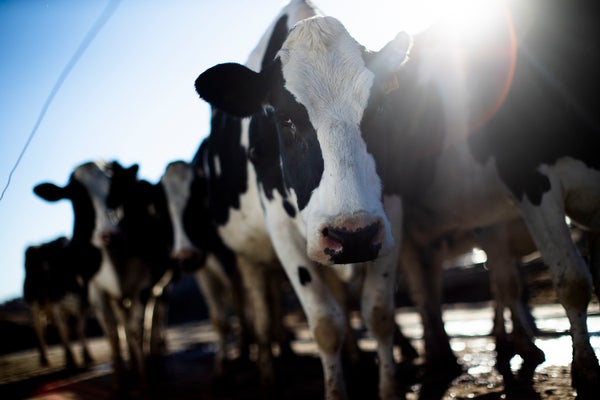
The outbreak of avian influenza in US dairy cattle shows no signs of slowing. Over the past three weeks, the number of states where cows infected with bird flu have been detected has risen from six to eight. A preprint1 posted on 16 April reported the discovery of the virus in raw milk from infected cows, and US federal authorities said on Wednesday that the virus had been found in lung tissue collected from a seemingly healthy cow.
Also on Wednesday, US officials confirmed at a media briefing that genomic material from the H5N1 strain, which is causing the outbreak, had been detected in milk sold in shops.
Detection of viral particles in milk sold to consumers suggests that avian flu in cows could “be more widespread than initially thought”, says food scientist Diego Diel at Cornell University in Ithaca, New York. “Increased surveillance and testing in dairies should be an important part of control measures going forward.” Nature looks at the implications for human health and the future of the outbreak.
On supporting science journalism
If you're enjoying this article, consider supporting our award-winning journalism by subscribing. By purchasing a subscription you are helping to ensure the future of impactful stories about the discoveries and ideas shaping our world today.
What does it mean that H5N1 is in retail milk?
It’s still unclear how many milk samples the FDA has tested or where the samples were collected. The agency said that it would release more information in the coming days and weeks.
After it leaves the farm and before it hits the shelves, milk is pasteurized to inactivate pathogens. To detect H5N1, the FDA used a test called quantitative polymerase chain reaction (qPCR), which picks up viral RNA. Because it detects fragments of the viral genome, the test cannot distinguish between living virus and the remnants of dead virus, says dairy scientist Nicole Martin at Cornell University.
“The detection of viral RNA does not itself pose a health risk to consumers, and we expect to find this residual genetic material if the virus was there in the raw milk and was inactivated by pasteurization,” she says.
The presence of viral material in commercially available milk does have broader implications, however. There are several possible explanations, says virologist Brian Wasik, also at Cornell University. It could be that the outbreak is more pervasive than farmers realized, and that milk from infected animals is entering the commercial supply. Another possibility, he says, is that “asymptomatic cows that we are not testing are shedding virus into milk”. But it’s also possible that both scenarios are true.
US federal rules require milk from infected cows to be discarded, but it’s not yet clear whether cows often start shedding the virus before they look sick or produce abnormal milk. The 16 April preprint, which has not yet been peer reviewed, includes reports that milk from infected cows is thicker and more yellow than typical milk and that infected animals eat less and produce less milk than usual.
Is milk with traces of H5N1 in it a threat to humans?
There is no definitive evidence that pasteurization kills H5N1, but the method kills viruses that multiply in the gut, which are hardier than flu viruses, says Wasik. “Influenza virus is relatively unstable,” he says, “and is very susceptible to heat.” Pasteurization of eggs, which is done at a lower temperature than pasteurization of milk, does kill H5N1.
It’s possible that pasteurization would be less effective at killing relatively high viral concentrations in milk, says Wasik. Finding out whether this is the case requires experimental data. In the absence of a definitive answer, keeping milk from infected cows out of the commercial supply is extremely important.
When Nature asked when to expect more evidence on whether pasteurization kills H5N1, Janell Goodwin, public-affairs specialist at the FDA in Silver Spring, Maryland, said that the agency and the US Department of Agriculture (USDA) “are working closely to collect and evaluate additional data and information specific to” H5N1.
Is milk spreading bird flu among cows?
USDA researchers have tested nasal swabs, tissue and milk samples of cows from affected dairy herds and have found that milk contained the highest viral concentrations. This indicates that the virus could be spreading through milk droplets.
If so, milking equipment could be involved. “The teat cups of a milking machine could transfer remnants of H5N1-containing milk from one cow to the teats of the next cow being milked,” says virologist Thijs Kuiken at Erasmus University Medical Centre in Rotterdam, the Netherlands. “Even if they are washed and disinfected, the levels of virus in the milk of infected cattle are so high that one could not exclude the possibility of infectious virus being transferred from cow to cow by this route.” In fact, in some equipment set-ups, workers spray down milking machines with high-pressure hoses to clean them, which would aerosolize any infected milk, says Wasik.
The USDA website concurs that viral spread is “likely through mechanical means”.
Is enough being done to stop the spread?
The FDA announced on Wednesday that cows must test negative for bird flu before they can be moved across state lines. That might help to stem the outbreak, scientists say. Animals in the US dairy industry move around a lot, Wasik says. Calves are moved to be raised into milk cows, cows are moved when they stop producing milk and farmers sell the animals. Such movement is probably “a main driver” of the outbreak, Wasik says.
Diel would like to see surveillance of bulk milk samples at farms. Wastewater testing and environmental sampling could be useful, too, Wasik says, particularly around farms near outbreaks or farms where cows have been moved. He also advocates for a quarantine or observation period of 24 or 48 hours when cattle are moved to a new farm.
Such surveillance measures “could really buy us time, slow down the outbreak”, says Wasik, so researchers and agencies can “get a better handle on it. Because time is what’s of the essence.”
This article is reproduced with permission and was first published on April 25, 2024.