
Nearly four decades ago zoologist Michael Thompson, then at the University of Adelaide in Australia, made an alarming discovery: invasive red foxes were gobbling up more than 90 percent of all the turtle eggs laid along the banks of Australia’s Murray River. Thompson’s surveys also revealed a disproportionate number of older turtles, suggesting that fox predation had already reduced the amount of juveniles in the river. If no one took action, he warned, the formerly abundant turtles would eventually disappear.
Very little was done, and Thompson’s prediction now appears to be on its way to coming true. A recent study confirms that several turtle species have either drastically declined or disappeared from various sections of the Murray River. “The problem is that the longevity of turtles gives the perception of persistence,” says Ricky Spencer, an ecologist at Western Sydney University and a co-author of the study, which was published in February in Scientific Reports. “It’s human nature that only when something is gone do we start missing it.”
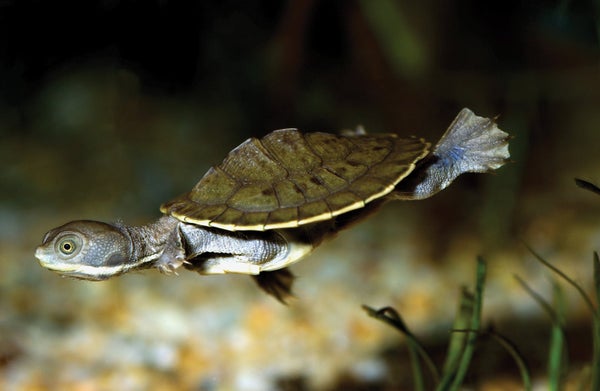
Spencer and his colleagues tallied populations of three once common turtle species—the broad-shelled turtle, the eastern long-necked turtle and the Murray River turtle—at 52 sites along the southern reaches of the river. The researchers inferred the species’ population sizes from the number of individuals they trapped in a given amount of time. They found the turtles have been extirpated in places where they were previously abundant, and most of the specimens they managed to capture elsewhere were large—and likely old—adults. Spencer and his colleagues blame the losses on ongoing nest predation by foxes, compounded by other problems, including environmental degradation and severe drought in the 2000s.
On supporting science journalism
If you're enjoying this article, consider supporting our award-winning journalism by subscribing. By purchasing a subscription you are helping to ensure the future of impactful stories about the discoveries and ideas shaping our world today.
“We have known about [the turtle die-off] for decades, and despite intense media hype in Australia about the ‘plight of our rivers,’ nothing has been done to reverse that decline,” says Rick Shine, a herpetologist at Macquarie University in Sydney, who was not involved in the research. “This paper is a wake-up call that unless we begin to do something about turtle conservation on a landscape scale, we may lose a fascinating component of our native fauna.”
The turtles could recover quickly if action is taken to protect nests from foxes and restore habitat, Spencer notes. But governments tend to respond only when losses reach crisis levels, and the Murray River species currently lack federal protection, he says. He and his colleagues have a work-around, however: “Our next step is to start designing community conservation efforts for common turtle species,” he explains, “so people can actually do things without having to wait for government funding.”