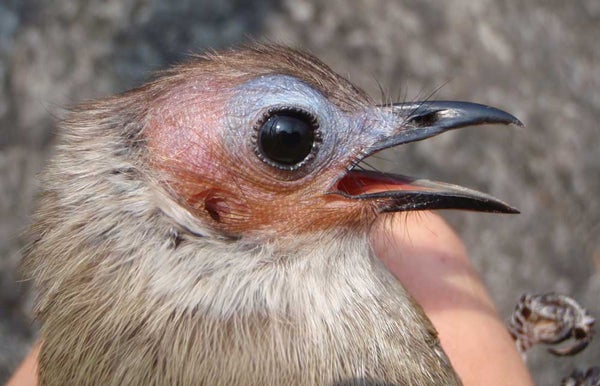
Researchers have discovered Asia's first bald songbird . The bare-faced bulbul ( Pycnonotus hualon ) makes its home in Laos and is the first one of its family (bulbul) to be discovered in Asia in more than a century.
IAIN WOXVOLD/UNIVERSITY OF MELBOURNE
Join Our Community of Science Lovers!
On supporting science journalism
If you're enjoying this article, consider supporting our award-winning journalism by subscribing. By purchasing a subscription you are helping to ensure the future of impactful stories about the discoveries and ideas shaping our world today.
Researchers have discovered Asia's first bald songbird. The bare-faced bulbul (Pycnonotus hualon) makes its home in Laos and is the first one of its family (bulbul) to be discovered in Asia in more than a century. The new species was reported yesterday online and will appear in the U.K.-based Oriental Bird Club's journal, Forktail, next month. The bare-faced bulbul is about the size of a thrush and lives in trees near limestone outcroppings.
"Its apparent restriction to rather inhospitable habitat helps to explain why such an extraordinary bird with conspicuous habits and a distinctive call has remained unnoticed for so long," co-author of the paper Iain Woxvold, of the University of Melbourne in Australia, said in a prepared statement.
Despite its name, the bird isn't entirely bald. The reporting authors describe a small line of fine feathers that run down the middle of its face.
It’s Time to Stand Up for Science
If you enjoyed this article, I’d like to ask for your support. Scientific American has served as an advocate for science and industry for 180 years, and right now may be the most critical moment in that two-century history.
SciAm always educates and delights me, and inspires a sense of awe for our vast, beautiful universe. I hope it does that for you, too.
If you subscribe to Scientific American, you help ensure that our coverage is centered on meaningful research and discovery; that we have the resources to report on the decisions that threaten labs across the U.S.; and that we support both budding and working scientists at a time when the value of science itself too often goes unrecognized.