
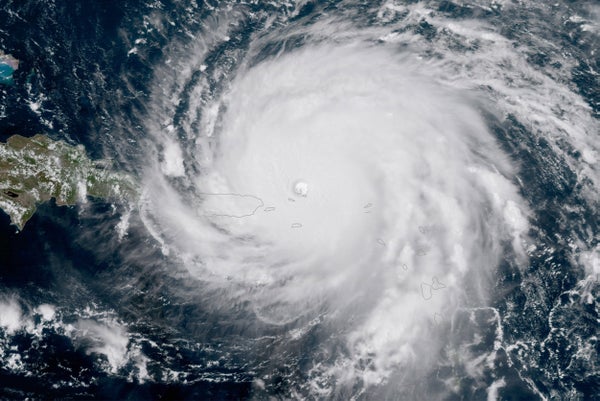
Hot on the heels of Harvey, Hurricane Irma is headed for the U.S. The category 5 storm is one of strongest on record in the Atlantic, with peak winds of 185 miles per hour. It has already ripped through Barbuda, Anguilla, Puerto Rico and other islands, destroying buildings and leaving thousands of people without water or electricity.
Florida is bracing for the storm’s arrival this weekend even as nearby Texas is still reeling from Harvey, a category 4 hurricane that put much of Houston underwater less than two weeks ago. If Irma hits the U.S. mainland, it will be the first time on record that two hurricanes of category 4 strength or higher have struck the country in one season. So how did two such violent hurricanes occur in rapid succession? Scientific American asked Jennifer Collins, a hurricane expert and an associate professor of weather and climate at the University of South Florida School of Geosciences Tampa.
[An edited transcript of the interview follows.]
On supporting science journalism
If you're enjoying this article, consider supporting our award-winning journalism by subscribing. By purchasing a subscription you are helping to ensure the future of impactful stories about the discoveries and ideas shaping our world today.
How can two such intense hurricanes—Harvey and then Irma—occur in a very short period of time?
For a hurricane to occur anywhere, you need certain conditions to be right. You need warm sea-surface temperatures, an environment of low wind shear, high humidity—and those are just a few of the conditions. So things have been just right.
How do these forces drive powerful storms?
The storm needs the warm sea-surface temperatures because they give the storm fuel and energy for the system. The high humidity is another energy source for the hurricane. When you get high humidity, condensation occurs. And in the process of condensation, latent heat is released. Latent heat provides additional fuel for the hurricane. The low wind shear [also contributes]. Let’s say your wind speed is strong, and the wind direction is opposite between the upper levels and the [ocean’s] surface—then you get a strong shearing environment. Then the winds basically shear the hurricane apart, and the hurricane disintegrates. But what we’ve had going on is the opposite. We’ve had a low-shear environment, so the difference between the upper level and lower level winds has been small. The storm does not get ripped apart, and can continue.
If Irma makes landfall in the U.S., it would be the first time on record that two hurricanes of category 4 strength or higher have hit the U.S. in a season. How does such a rare event happen?
The research is showing that with climate change we might be seeing more intense storms. So the fact that they are major, that does link up with the climate change research.
We’ve also got a season where we have these conducive conditions, so the environment is just right for them.
Did Harvey and Irma both gain fuel from those ideal conditions in the same location?
Each intensification happened for separate reasons. With Harvey it was due to an eddy—deep warm water in the Gulf of Mexico—that broke off the warm loop current. Harvey was a tropical storm in the Caribbean and degenerated into an open wave, and then rapidly intensified in the Gulf of Mexico when it [moved] over the eddy. Irma formed in Atlantic [and] steadily intensified. [It is] such a rare event [in the case of the latter] to have sustained wind speeds of 185 miles per hour.
So no, they did not form in the same area—[and] those conducive conditions needed for hurricanes are not [found] throughout the Atlantic.
Is it a surprise that two such intense storms would occur back to back?
It’s a very rare event to get one, and then to have had two—it’s an extremely rare event.