
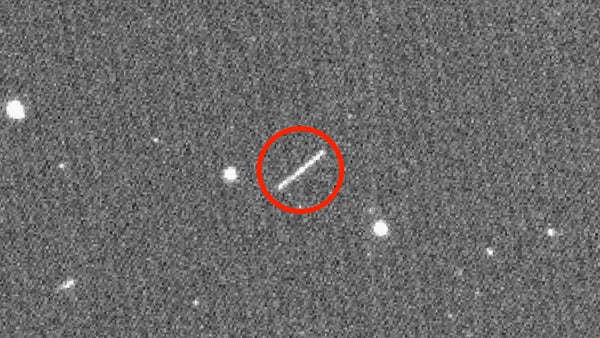
A newly discovered car-sized asteroid just made the closest-known flyby to Earth without hitting our planet.
On Sunday (Aug. 16), the asteroid, initially labeled ZTF0DxQ and now formally known to astronomers as 2020 QG, swooped by Earth at a mere 1,830 miles (2,950 kilometers) away. That gives 2020 QG the title of closest asteroid flyby ever recorded that didn’t end with the space rock’s demise.
It’s the closest known, non-impacting asteroid, NASA officials told Space.com
On supporting science journalism
If you're enjoying this article, consider supporting our award-winning journalism by subscribing. By purchasing a subscription you are helping to ensure the future of impactful stories about the discoveries and ideas shaping our world today.
The flyby wasn’t expected and took many by surprise. In fact, the Palomar Observatory didn’t detect the zooming asteroid until about six hours after the object’s closest approach. “The asteroid approached undetected from the direction of the sun,” Paul Chodas, the director of NASA’s Center for Near Earth Object Studies, told Business Insider. “We didn’t see it coming.”
“Yesterday’s close approach is [the] closest on record,” Chodas told Business Insider. “If you discount a few known asteroids that have actually impacted our planet.”
The close flyby was also a fast one, as 2020 QG swooped near Earth at a blistering 27,600 mph (44,400 kph). The object is about the size of a compact car, perhaps about 10 to 20 feet (3 to 6 meters) in diameter.
According to the International Astronomical Union’s Minor Planet Center, 2020 QG flew over the Pacific Ocean, far east of Australia, during its close approach. To explore the daredevil asteroid for yourself, you can check out NASA’s Jet Propulsion Laboratory’s small-body database browser here.
Copyright 2020 Space.com, a Future company. All rights reserved. This material may not be published, broadcast, rewritten or redistributed.