
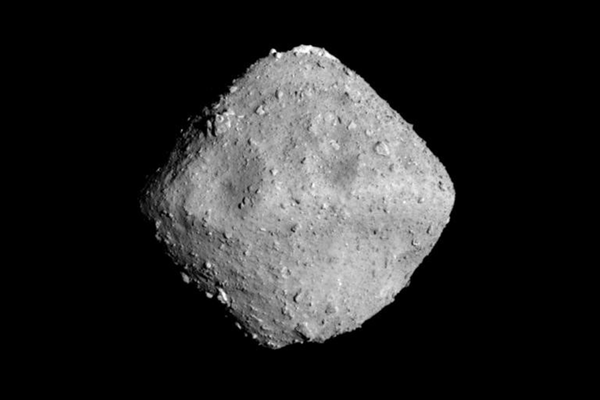
After inspecting asteroid Ryugu for two months, the Japan Aerospace Exploration Agency (JAXA) has revealed the sites where the Hayabusa2 spacecraft will touchdown to collect a sample to bring back to Earth—and also where it will drop the first two of its planned landing probes.
Mission planners faced tough choices because the body almost uniformly strewn with boulders. “Ryugu is beautiful, but challenging,” said Aurélie Moussi, a collaborator from the French space agency CNES in Toulouse, at a press conference in Sagamihara, Japan, on 23 August.
Hayabusa2 is the follow-up mission to Hayabusa, a probe that was the first to collect samples from an asteroid and bring them back to Earth in 2010. The latest mission reached Ryugu in June, after three and a half years of travel from Earth.
On supporting science journalism
If you're enjoying this article, consider supporting our award-winning journalism by subscribing. By purchasing a subscription you are helping to ensure the future of impactful stories about the discoveries and ideas shaping our world today.
Since then, Hayabusa2 has been hovering a few tens of kilometres above the space rock and scanning its surface as it revolves every seven-and-a-half hours. The spacecraft also made a closer approach earlier this month, temporarily letting itself fall down to an altitude 851 metres. By measuring the speed of that free fall, mission control was able to estimate the mass of the asteroid, at about 450 million tonnes.
Three landers
Hayabusa2 carries three landers that it will eject to the asteroid over its mission. It will also touch down itself to collect samples to return to Earth. In today’s press conference, members of the mission team described how they picked the sites for the first of two touchdowns and for releasing MASCOT—a lander built by the French and German space agencies—and the first of the two MINERVA-II landers, built by a Japanese consortium.
In early October, Hayabusa will temporarily fly down to an altitude of 60 metres to drop MASCOT. The operation will involve some risk: the shoebox-sized lander does not have the ability to steer itself, and mission control can predict where it will hit the ground only within a region around 70 metres wide. After that first impact—at a leisurely speed of around 30 centimetres per second—MASCOT will bounce in an unpredictable direction, and its final arrival place is even more uncertain, by hundreds of metres.
“Until we land, we don’t know how it looks on the landing site,” TraMi Ho of German space agency DLR said at the press conference.
To minimize risks for MASCOT, mission planners mapped the topography of Ryugu and the distribution and size of the boulders on its surface. They ran computer simulations to produce a shortlist of ten options, and then picked one spot on the asteroid’s southern hemisphere. The choice reflected a number of criteria, including average temperatures on the ground and the materials that MASCOT will analyse with its four on-board instruments. “The other sites would have been just as good, or just as difficult,” says MASCOT payload manager Stephan Ulamec of the German Aerospace Center in Cologne. “Wherever we look, there is a lot of big boulders.”
Itokawa, the potato-shaped asteroid visited by the first Hayabusa, had a more diverse surface, Ulamec says, and the mission team team was able to choose a lower-risk landing site in a sandy area, which they named the Muses Sea.
Hayabusa2 will make its first touchdown, planned for late October, at a site just north of the equator. The first of two MINERVA II probes will land in late September.
This article is reproduced with permission and was first published on August 23, 2018.