
On supporting science journalism
If you're enjoying this article, consider supporting our award-winning journalism by subscribing. By purchasing a subscription you are helping to ensure the future of impactful stories about the discoveries and ideas shaping our world today.
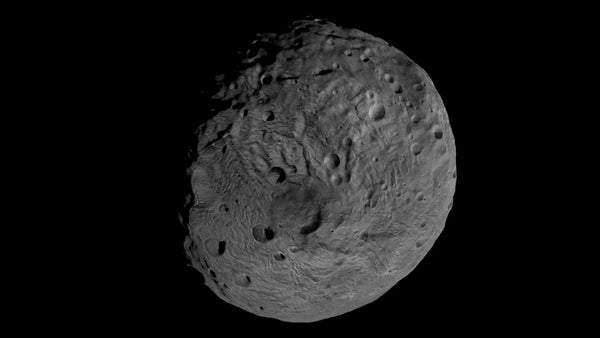
NASA's Dawn spacecraft captured this shot while orbiting the asteroid Vesta at a distance of 2,700 kilometers. The image is part of a newly released batch of the most close-up photos ever taken of one of the largest asteroids in the solar system.
The image depicts the pockmarked southern pole of Vesta, a main-belt asteroid around 184 million kilometers away. A massive crater takes up most of the image, its rim outlined on one side by shadows cast from the asteroid's nighttime side. Although Hubble first imaged the 400-kilometer-wide crater in 1997, Carol Raymond, project scientist for the Dawn mission, said the new higher-resolution images held a few surprises.
"In a crater you think you're going to see a bowl, but this is more flat," Raymond says. "In this case, it looks like the impact was large enough to blow the polar cap off the asteroid."
Another surprise was found at the center of the depression, where a mound (not visible in image) rises 15 kilometers from the crater floor. At nearly twice the height of Mount Everest, the formation is one of the highest in altitude in the solar system. "It has no analogue on other planetary bodies that we're aware of," Raymond said. "We can't explain it. It's a very unusual feature."
In October, after Dawn beams back images with four times the resolution of the latest photos, Raymond and her team are hoping to get a clearer understanding of the processes behind the asteroid's unusual topography.
--Sarah Fecht