
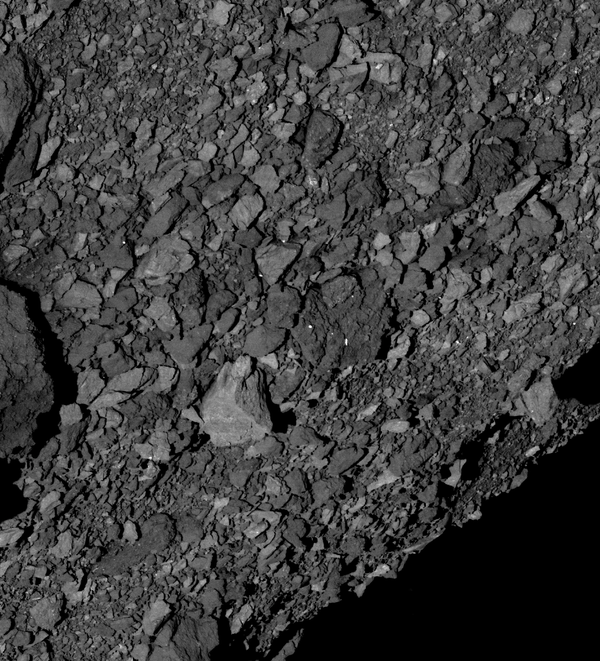
The first U.S. attempt to bring asteroid dust back to Earth has hit a surprise hurdle. The near-Earth asteroid Bennu is rockier and expelling more debris than expected, according to results from NASA’s OSIRIS-REx spacecraft, which is currently orbiting Bennu. The findings could threaten NASA’s plan to scoop up a sample from the asteroid’s surface next year.
The U.S.$800-million mission is not the only one in the process of scoping out an asteroid. Japan’s Hayabusa probe returned the first asteroid sample in 2010, and its successor Hayabusa2 is currently trying to gather its second from the asteroid Ryugu. Both missions aim to explore what asteroids can reveal about the birth and evolution of the Solar System, such as whether they are a source of Earth's water.
Boulder dodge
On supporting science journalism
If you're enjoying this article, consider supporting our award-winning journalism by subscribing. By purchasing a subscription you are helping to ensure the future of impactful stories about the discoveries and ideas shaping our world today.
OSIRIS-REx has been orbiting the 490-metre-wide, diamond-shaped Bennu since last December. The most significant finding for the mission so far is that Bennu is dotted with big boulders. Scientists had expected fine-grained sand and designed the craft’s sampling device to collect samples smaller than 2 centimetres. Now OSIRIS-REx will need to navigate its way carefully down to one of the few sandy patches that do exist.
“It’s a little more of a rugged environment than we had designed to,” says Dante Lauretta, a planetary scientist at the University of Arizona in Tucson and the mission’s principal investigator. “That definitely caught us by surprise,” he says. Lauretta and several other team members described the latest findings at the Lunar and Planetary Science Conference in The Woodlands, Texas, today.
Results from the mission also appeared in a collection of seven papers published today in Nature, Nature Astronomy, Nature Geoscience and Nature Communications.
The second big challenge is that OSIRIS-REx has seen small particles spraying off the asteroid’s surface about once or twice a week. The particles fly instantaneously from different places on Bennu, perhaps as ice vaporizes and sprays outwards. “It’s an active object,” says Lauretta. “That really caught us by surprise.” Bennu is the first active asteroid that scientists have seen up close.
The particles are too small to hurt the spacecraft, but they complicate NASA’s plans to retrieve a sample in July 2020 and return it to Earth in 2023. If gases are spraying out unpredictably, mission controllers need to prepare for how that might affect the craft.
“This is what discovery is all about—surprises, quick thinking and doing what it takes to get good science,” said Lori Glaze, acting director of NASA’s planetary-science division in Washington DC, in a statement. “I am confident that the scientists and engineers will get us a sample of Bennu.”
Inertia rethink
Before OSIRIS-REx launched in 2016, mission scientists thought they understood the size of particles on Bennu’s surface. They had estimated the asteroid’s thermal inertia, which is a measure of how slowly or how quickly it changes temperature to match that of the environment around it. A high thermal inertia means it would take a long time to heat up or cool down, so would point to big rocks; a low thermal inertia, by contrast, suggests the presence of small particles.
Measurements taken by the Spitzer Space Telescope suggested that the asteroid had a low thermal inertia, and was covered in particles smaller than a centimetre.
OSIRIS-REx has now confirmed that Bennu’s surface does have a low thermal inertia—but instead of sandy particles, it is covered by more than 200 boulders. To have such a low thermal inertia, those boulders might be full of holes or covered in layers of dust, says team member Josh Emery, a planetary scientist at the University of Tennessee in Knoxville.
Hayabusa2 found that Ryugu’s boulders seem to be porous, rather than covered in dust, which the mission team reports in Science today.
Both Ryugu and Bennu turned out to be rockier than expected from their thermal-inertia measurements, says Andrew Rivkin, a planetary scientist at the Johns Hopkins University Applied Physics Laboratory in Laurel, Maryland. That could mean that researchers don’t quite understand the thermal properties of carbon-rich asteroids, a category to which both Ryugu and Bennu belong.
Patch picking
The OSIRIS-REx team had hoped to briefly touch down in broad sandy swathes more than 25 metres across, but that now doesn’t seem likely. So, mission engineers are developing ways to navigate down to patches that measure just 5–10 metres across. They are upgrading the spacecraft’s software to be more autonomous, so that it can analyse the surface below and correct or abort as needed as it moves in for a sample. The team will pick a primary and a back-up site and analyse both before deciding which to go for.
As the spacecraft descends towards Bennu’s surface and hovers above it, the craft will extend its 3.3-metre-long sampling arm, spit out a puff of gas and hoover up the dust and rocks it dislodges from the surface. OSIRIS-REx does not carry an explosive to shatter the surface into fragments, as Hayabusa2 does. Hayabusa2 is expected to fire that explosive at Ryugu in the next few weeks.
Other findings from OSIRIS-REx include the discovery of the iron-rich mineral magnetite on Bennu’s surface, which could indicate that water once flowed through the asteroid. The spacecraft also spotted water bound in clay minerals.
The team now has more than a year to prepare for where and how to taste the asteroid. “We will get a sample,” says Lauretta. “That’s what we’re there to do.”
This article is reproduced with permission and was first published on March 19, 2019.