
Chiral molecules are those that come in two forms: versions that are mirror images of one another but cannot be superimposed, like right and left hands. Life seems to prefer molecules of a single chemical handedness, however. All DNA, for example, twists clockwise like the threads on a right-handed screw. Nearly all amino acids, meanwhile, are left-handed. Why one or the other? “It's pretty well established that once an excess [of one chirality] is present, life is going to go with it,” says Brett McGuire, an astrochemist at the National Radio Astronomy Observatory in Charlottesville, Va. For instance, if DNA came in both forms, its strands would not fit together, and life probably would not have gotten far.
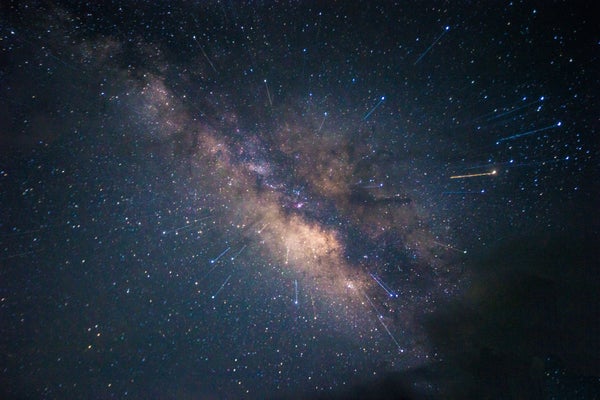
Although it is possible such an excess originated with meteors that brought mostly one type of molecule or another to Earth early in its history, another hypothesis suggests the origins of chirality are much older. As reported in Science, McGuire and his colleagues have discovered a chiral molecule in interstellar space. The compound, propylene oxide, exists in Sagittarius B2, a cloud of gas and dust near the center of the Milky Way.

Graphic by Amanda Montañez
On supporting science journalism
If you're enjoying this article, consider supporting our award-winning journalism by subscribing. By purchasing a subscription you are helping to ensure the future of impactful stories about the discoveries and ideas shaping our world today.
The observation shows that chiral molecules were present “way before solar systems,” says P. Brandon Carroll of the California Institute of Technology and a co-author of the paper. If these types of molecules were mostly right-handed, they could have seeded the formation of other right-handed molecules, ultimately including DNA, long before our sun first shone. If so, that right-handed excess could have been baked into Earth's chemistry as it was forming rather than being added by meteors after the fact.
NASA astrochemist Stefanie Milam says the implications are “huge” for astrobiology because they suggest that at least some of the complex chemistry associated with life is present elsewhere in the universe. Others are skeptical. Arizona State University biochemist Sandra Pizzarello, who has studied chiral molecules in meteorites, says connecting the observations to DNA chirality could be difficult. “We are still left wondering what happens” on the long path between molecular clouds and the origins of life, she says.
McGuire is now testing whether a majority of the propylene oxide molecules are right- or left-handed.