
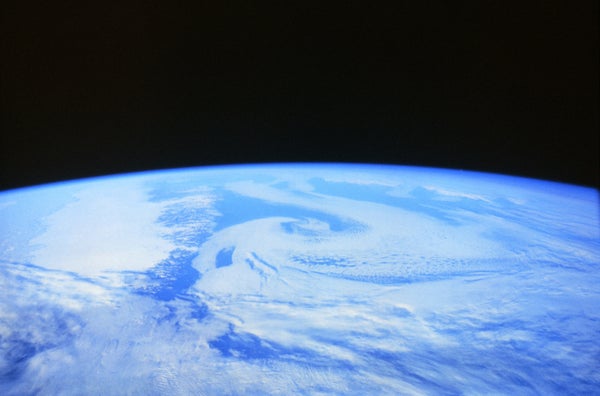
Astronauts—not cinematographers—captured the stunning visuals in the new IMAX movie, A Beautiful Planet: gorgeous views of Earth shot from the International Space Station (ISS), often with parts of the station visible in the frame. Sweeping vistas of continents at night—when webs of light reveal a human presence that is almost impossible to detect during the day—contrast with inside scenes of an ISS that is crammed with equipment but somehow looks almost homey, as described by the narrating astronauts. Both threads come together in the 45-minute film, which depicts life in space to make a powerful point about taking care of Earth.
“It was originally going to be a look at the Earth,” explains the film’s cinematographer James Neihouse. “But one of the things NASA always needs is a reason to be. So we could make the film from that point of view, using the space station as this platform to observe the Earth.”
Highlighting the ISS also helped further one of the film’s core messages: Just as the craft enables astronauts to live in space in exchange for continual maintenance and care, Earth is humanity’s equivalent of a space station and needs to be treated in the same manner. “I wanted to use the analogy of the ISS being a closed system that needs to be maintained in a very careful way, that resources are very limited,” says producer–director Toni Myers. “I wanted to convey to the audience that Earth is basically the same—although Earth doesn’t get any resupply ships.”
On supporting science journalism
If you're enjoying this article, consider supporting our award-winning journalism by subscribing. By purchasing a subscription you are helping to ensure the future of impactful stories about the discoveries and ideas shaping our world today.
Myers is no stranger to space-based movies: This is her seventh full IMAX movie set in space, and her projects span the U.S. space shuttle program and Hubble Space Telescope, along with the ISS and the now-deorbited Russian space station Mir. Going into this one, she had a list of shots she wanted and three astronauts were responsible for capturing as many of them as possible. The filming was done by U.S. astronauts: Butch Wilmore, member of Expedition 41, excelled at capturing shots of Earth; Terry Vrits of Expedition 42 captured life on the ISS itself; and Kjell Lindgren of Expedition 44 came through with some of the trickier shots, such as the aurora borealis and the now-famous space-grown lettuce. Their international colleagues including Samantha Cristoforetti of Italy, Japan’s Kimiya Yui and Russian cosmonaut Yelena Serova appear in the footage.
On Earth it can be easy to forget that everything in the universe is continuously in motion. But it is impossible to forget when one is trying to film the spinning Earth from the hurtling ISS. “If you see it, it’s too late,” says astronaut Vrits, a longtime amateur photographer who has taken somewhere between 350,000 and 500,000 shots in space. “Obviously I’m a camera guy, so it’s good I was on this mission.”
Shooting a film on the ISS involves some of the mundane concerns also presented on the ground, such as properly framing a shot and making sure the microphone is turned on. But filming in weightlessness brings its own slew of challenges. “The zero-g experience is a big difference. You think it’s going to be so much easier to move the camera around but it’s also a bad thing,” cinematographer Neihouse explains. When cameras are suddenly weightless it can be easy to accidently capture jerky, difficult-to-watch footage. The astronauts started training for the task at least a year before they began filming.
A Beautiful Planet also had to be filmed with digital cameras rather than the ones used in previous space-based IMAX movies due to ISS cargo weight and size restrictions. This came with an added benefit, however: Footage could be transferred back to the production team on Earth overnight, so astronauts could see the results of their filming with very little wait time.
All the astronauts on the ISS have full-time day jobs in taking care of the spacecraft, monitoring scientific experiments and attending to their own bodies—so filming became an after-hours task. “We basically filmed the whole movie on our spare time,” Vrits says.
The astronauts involved know that watching a film like A Beautiful Planet will be the closest most people will come to life in orbit, and they all agreed that the power of the medium to bring that perspective to Earth is of utmost importance. “From the astronaut’s perspective, we desperately want to share that experience,” Lindgren explains. “It makes you want to be a better steward of our planet, and movies like this are another way to share that experience and help people change their perspectives.”
“I think this is my favorite, most important accomplishment,” Vrits says, adding, “Unless one of the others solves cancer. In the absence of that, I’ll say this is.”