
On supporting science journalism
If you're enjoying this article, consider supporting our award-winning journalism by subscribing. By purchasing a subscription you are helping to ensure the future of impactful stories about the discoveries and ideas shaping our world today.
With just weeks to go before the launch of NASA's final shuttle mission, dubbed STS-135, the four astronauts who will be on board Atlantis are wrapping up their training.
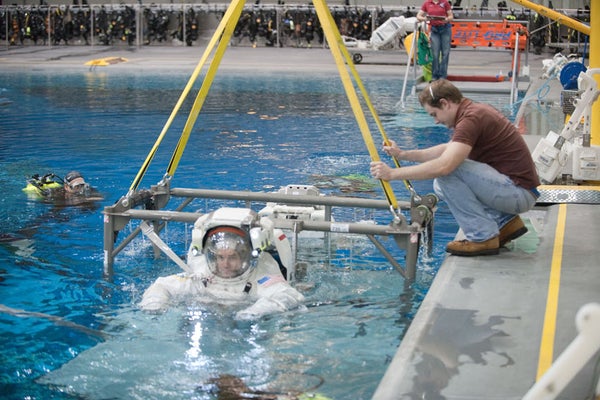
In this photo, astronauts Rex Walheim and Sandy Magnus (her back is visible) finish a spacewalk training session on June 13. Both wear training versions of the bulky Space Shuttle Extravehicular Mobility Unit (EMU), a high-tech garment that includes its own oxygen supply, electrical power, drinking water (with a straw connecting to the helmet) and other survival gear.
Walheim and Magnus are emerging from the water in NASA's Neutral Buoyancy Laboratory (NBL), where astronauts can practice under conditions that simulate the weightlessness they will experience in orbit. The NBL, which is 12 meters deep and holds 23.5 million liters of water, does not actually make astronauts weightless. But neutral buoyancy—wherein objects and people essentially float underwater—offers one of the best training tools for astronauts to rehearse complex zero-gravity operations.
The STS-135 crew will have 12 days to complete their mission to the International Space Station, which includes delivering supplies and spare parts, returning a failed ammonia pump and launching an experiment to test the logistics of robotically refueling satellites, including those that were not originally designed for such operations.
—Lauren F. Friedman