
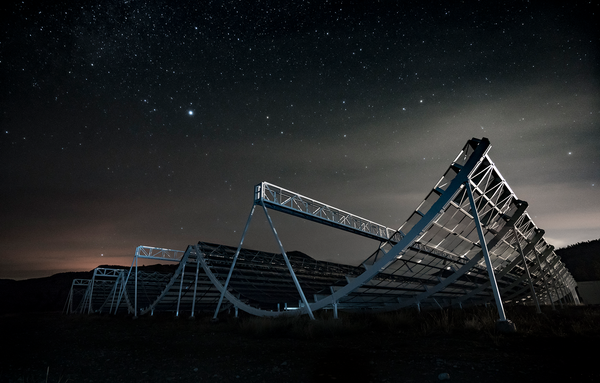
Astronomers are edging closer to discovering what causes brief, powerful flashes in the sky known as fast radio bursts (FRBs), after a Canadian telescope discovered eight more of the most intriguing type of these blasts—those that repeat their signals.
FRBs are intensely energetic events that flare for just milliseconds, seemingly all over the sky and from outside the galaxy. But their cause has remained a mystery since the first FRB was identified in 2007. Astronomers hope that studying bursts that repeat their flashes, rather than just flare once, can help to elucidate the origins of FRBs. That’s because it’s easier for high-resolution telescopes to make follow-up observations of ‘repeaters’ and trace their origins than of one-off blasts.
Of the roughly 75 FRBs seen before this month’s discoveries, just 2 bursts were known to be repeaters. The first of these has been extensively studied, and the Canadian Hydrogen Intensity Mapping Experiment (CHIME) telescope discovered the second repeater earlier this year. CHIME’s latest results, published on the arXiv preprint server on 9 August, now show that repeaters are far from rare. In the past few weeks, another telescope, the Australian Square Kilometre Array Pathfinder, also found a repeater, bringing the total so far to 11—although researchers are yet to publish this result.
On supporting science journalism
If you're enjoying this article, consider supporting our award-winning journalism by subscribing. By purchasing a subscription you are helping to ensure the future of impactful stories about the discoveries and ideas shaping our world today.
CHIME, which began hunting for FRBs in 2018, has also discovered hundreds of one-off FRBs, CHIME researcher Bryan Gaensler said on Twitter on 12 August. Members of the telescope collaboration are still analysing these events, said Gaensler, an astronomer at the University of Toronto, Canada. “In 25 years of astronomy research, this is unquestionably the most exciting project I’ve ever worked on,” he said.
Scattered events
“This is a pretty exciting result,” says astronomer Laura Spitler at the Max Planck Institute for Radio Astronomy in Bonn, Germany. Astronomers’ priority will be to search for the host galaxy of these repeat signals, she says. Pinpointing the host galaxies is essential to cracking the mystery of what causes FRBs. And sketching a picture of the environments in which the blasts are born will allow researchers to whittle down some of the dozens of possible explanations for FRBs. Astronomers suggest that they could be emissions from young magnetars—dense star cores spinning in a magnetic field— or vibrating cosmic strings.
The findings mean that there are now enough repeaters to start comparing these with one-off blasts, to find out whether the two kinds of FRB are produced in similar environments, says Spitler. All FRBs could come from fundamentally similar environments, but perhaps repeat blasts had avoided detection until now or their sources only flare under certain conditions. Or each type could be caused by different events—one that repeats and one that doesn’t.
The CHIME team has already seen clues that could help to answer this question. The eight repeaters seem to be located within a similar range of distances to the one-off bursts. But repeater signals lasted longer on average, the collaboration reports. Spitler says that, if this trend holds, it could be a sign that two seperate phenomena cause the different types of blast, because a— the duration of a blast reflects the underlying mechanism that produces it.
Elusive environments
The latest data reveal differences in the environments from which repeaters emanate. A previously discovered burst, FRB 121102—the only repeating signal whose precise host galaxy has been identified—came from a highly magnetized environment. Like FRB 121102, the signal of one of the latest bursts is polarized with a spiral pattern that suggests it comes through a magnetic field. But the strength of the field for the new repeater is around 100 times weaker than that of FRB 121102.
Many, although not all, of the latest haul also share a feature of the first two repeaters. Rather than being a simple blast with a narrow frequency, the signals descend in frequency in a way that the team compares to a ‘sad trombone’ sound. “Such ‘sad trombone’ signals are actually rather unusual and complicated,” says Spitler. Explaining them poses a challenge to theorists, she adds.
The findings are only a small preview of the “full awesomeness coming out of CHIME”, said Gaensler. The telescope, which is near Penticton in British Columbia, was initially built to study radio waves from the early Universe. But in 2013, astronomers realized that the half-pipe-shaped telescope, which every day sweeps almost the entire northern sky, could also spot FRBs. For the relatively low cost of US$16 million, they turned CHIME into an FRB-hunter. Astronomers had only recently begun to take the telescope seriously, after initial observations seemed to be caused by interference or instrumental glitches.
“CHIME is definitely living up to its promise”, says Spitler.
This article is reproduced with permission and was first published on August 13, 2019.