
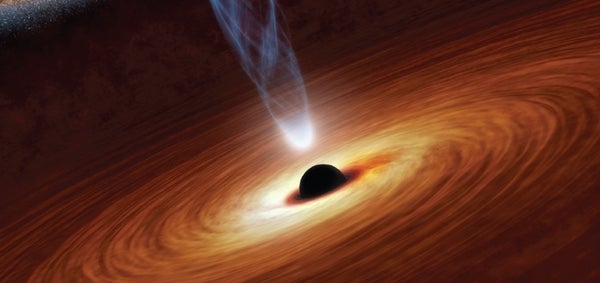
Black holes may be massive, but they are also extraordinarily compact. That combination of properties makes them challenging regions to evaluate across vast cosmic distances. To learn more about these objects' physical properties, astronomers must therefore come up with measuring tricks. An international team of astronomers recently invented a new one: in the Astrophysical Journal Letters, the members report how to determine a black hole's spin using the interactions of two giant holes bound in mutual orbit.
OJ 287, a binary supermassive black hole system, sits about 3.5 billion light-years from Earth. The duo's primary black hole weighs in at an estimated 18 billion solar masses; the second is a mere 150 million solar masses. Because of this dramatic inequality in size, the smaller hole follows an orbit that punches through a disk of superheated matter swirling around the larger hole. These “outburst” events always occur within a 12-year orbit and are read by astronomers as changes in the system's visible light, which is for the most part produced by the superheated material.
The predictability of this phenomenon and the associated precession, or shifting, of the smaller hole's elliptical orbit helped the astronomers to prepare for two outbursts at OJ 287 in November and December 2015. By precisely measuring the variation in light radiation from the system during those outbursts, the astronomers were able to indirectly measure the spin of the larger black hole. They found that it is spinning at 31 percent of the maximum allowed according to general relativity.
On supporting science journalism
If you're enjoying this article, consider supporting our award-winning journalism by subscribing. By purchasing a subscription you are helping to ensure the future of impactful stories about the discoveries and ideas shaping our world today.
These data, along with earlier observations, clearly indicate that the orbital period is getting shorter with time. That is because the system is losing energy as it emits gravitational waves—ripples in spacetime that steal energy from the holes' orbits, causing them to contract. In other words, in OJ 287 astronomers are witnessing the gradual merging of two supermassive black holes. And as most couples know, outbursts and fast pivots are likely to occur in the run-up to any merger.