
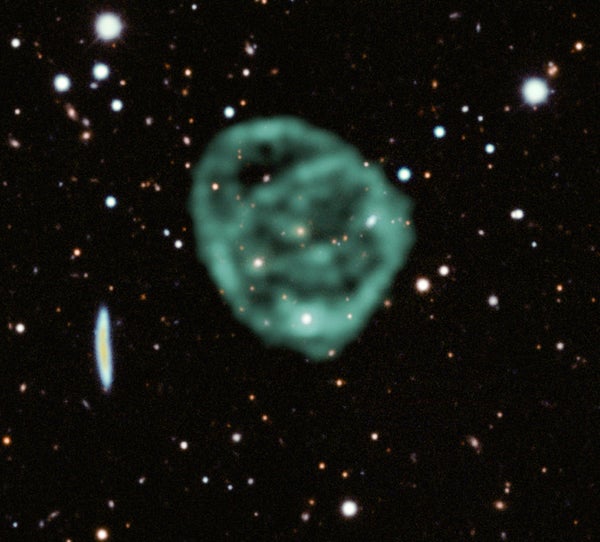
Astronomers have captured a close-up image of a rare and mysterious space object, prompting a renewed push to discover its origin. Odd radio circles (ORCs) are gigantic rings of radio waves. Only five have ever been sighted, and never in such spectacular detail.
The image of ORC J2103-6200, also called ORC1, was captured by the high-resolution MeerKAT radio telescope in South Africa, which has given researchers unprecedented information about these rare phenomena. Details are reported in a preprint, posted on the arXiv this week, and will be published in Monthly Notices of the Royal Astronomical Society.
“This discovery will start new scientific research among astronomers,” says Alice Pasetto, a radio astronomer at the National Autonomous University of Mexico in Mexico City.
On supporting science journalism
If you're enjoying this article, consider supporting our award-winning journalism by subscribing. By purchasing a subscription you are helping to ensure the future of impactful stories about the discoveries and ideas shaping our world today.
The new MeerKAT radio data shows that the ORC’s large outer circle is possibly more than a million light years across, ten times the diameter of the Milky Way, with a series of smaller rings inside. “It really reminds me of a Fabergé egg or a soap bubble,” says Bärbel Koribalski, a radio astronomer at Australia’s Commonwealth Scientific and Industrial Research Organisation in Sydney.
The first three ORCs, including ORC1, were discovered using the Australian Square Kilometre Array Pathfinder (ASKAP) telescope in 2019. A fourth was identified in archival data from India’s Giant MetreWave Radio Telescope in 2013, and a fifth was discovered by Koribalski in newer ASKAP data last year. Most of the ORCs have a galaxy at their centre, which astronomers suggest might have something to do with their creation. Also puzzling to scientists is the fact that ORCs have been spied only in radio wavelengths and have not been detected by optical or X-ray telescopes.
Origin unknown
Researchers have proposed three theories to explain the origin of ORCs. The first is that they are created from a shock wave from the centre of their galaxy, similar to what happens when two supermassive black holes merge.
The second theory is that they result from the activities of an active galactic nucleus, with radio jets spewing particles to create the ORC’s shape. The third theory is that ORCs are shells caused by starbursts in the centre of their galaxies. “Like a detective, we’re gathering more and more clues as to what this object possibly could be,” says Koribalski.
The ORCs detected so far have mostly been found using ASKAP, because of its huge field of view. Radio telescopes are generally able to view an area the size of the Moon, whereas ASKAP can scan areas 100 times bigger. Once ASKAP had spotted ORC1, MeerKAT was used to examine it in more detail because its higher resolution provides a much sharper radio image.
“The ORC project is a great example of the clever use of MeerKAT by its users, playing to its strengths: ASKAP observes large swathes of the sky and can discover relatively rare types of objects; MeerKAT can then follow up to study them in greater detail,” said Fernando Camilo, chief scientist at the South African Radio Astronomy Observatory in Cape Town, in a press release. The observatory built and operates MeerKAT.
Koribalski says that other high-resolution radio telescopes around the world will probably soon be pointing towards these objects, particularly once the next generation of these instruments come online in the next few years. These include the Square Kilometre Array, which will have thousands of antennas across two sites in Australia and South Africa, and the Next Generation Very Large Array in the United States.
“Without any doubt, radio astronomers will be attracted to this new kind of object,” says Pasetto.
This article is reproduced with permission and was first published on March 25 2022.