
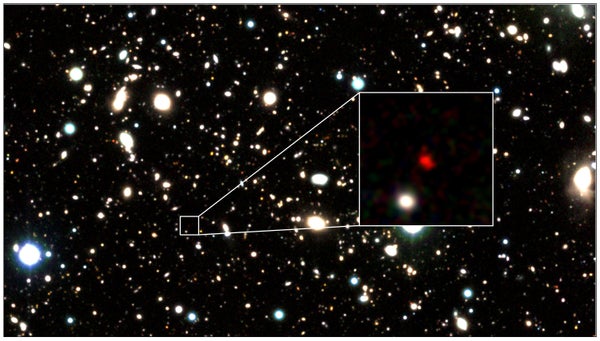
Researchers have spotted what might be the farthest astronomical object ever found — a galaxy candidate named HD1 that they estimate is 13.5 billion light-years away. That's an astonishing 100 million light-years more distant than the current farthest galaxy,
GN-z11.
HD1 is particularly bright in ultraviolet light, indicating highly energetic activity in the galaxy. As such, scientists originally theorized it might be a
On supporting science journalism
If you're enjoying this article, consider supporting our award-winning journalism by subscribing. By purchasing a subscription you are helping to ensure the future of impactful stories about the discoveries and ideas shaping our world today.
starburst galaxy, or one that produces stars at a relatively high rate. But upon closer inspection, astronomers discovered that the galaxy candidate was producing more than 100 stars annually — a rate 10 times higher than typical starburst galaxies.
Now researchers suggest two new possibilities to explain the extreme energy emitted from the galaxy. On the one hand, it might have a
supermassive black hole 100 million times as massive as the sun at its center; that would be the oldest black hole that size ever observed. On the other hand, HD1 might be home to some of the universe's very first stars, which astronomers haven't been able to observe to date.
"The very first population of stars that formed in the universe were more massive, more luminous and hotter than modern stars," Fabio Pacucci, co-author of the study announcing the discovery and an astronomer at the Harvard-Smithsonian Center for Astrophysics,
said in a statement.
These stars, called
Population III stars, are believed to produce much higher levels of ultraviolet light than typical stars, potentially explaining HD1's brightness.
If astronomers prove that HD1 does have Population III stars, it would mark the first time these objects have ever been observed.
Astronomers spotted HD1 during 1,200 hours of observation with the
Subaru Telescope in Hawaii, VISTA Telescope in Chile, the U.K. Infrared Telescope, and NASA's now-retired Spitzer Space Telescope, then confirmed its distance with observations gathered by the Atacama Large Millimeter/submillimeter Array (ALMA) in Chile. The team will soon observe HD1 with the James Webb Space Telescope to further verify their calculations, they said.
The
discovery was published Thursday (April 7) in the Astrophysical Journal, with an accompanying paper in the Monthly Notices of the Royal Astronomical Society Letters.
Copyright 2022 Space.com, a Future company. All rights reserved. This material may not be published, broadcast, rewritten or redistributed.