
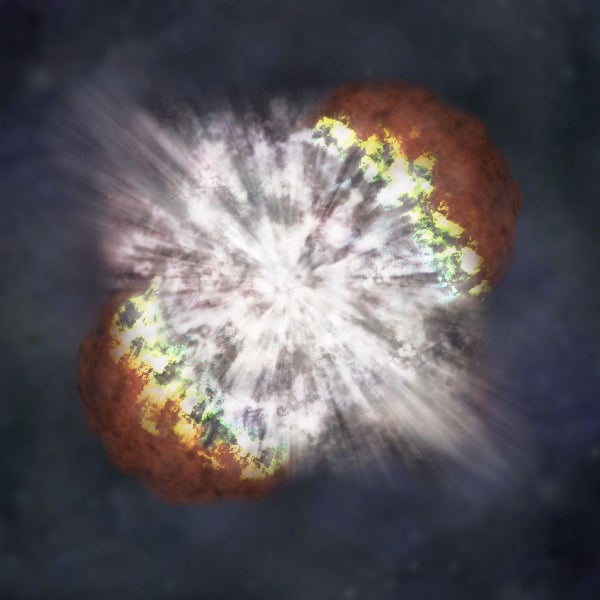

An extraordinarily powerful "hypernova" a whopping 10.5 billion light-years from Earth is the most distant star explosion ever observed, a new study reports.
The Big Bang occurred about 13.8 billion years ago, which means that light from the hypernova, or superluminous supernova (SLSN), has been streaking through space for about three-quarters of the universe's existence.
Astronomers first spotted hypernovas just a decade or so ago. As the name suggests, these objects are extreme versions of "normal" supernovas. Several different phenomena may trigger these hypernovas, including the infall of material onto neutron stars, the rapidly rotating corpses of once-massive stars, study team members said. [Supernova Photos: Great Images of Star Explosions]
On supporting science journalism
If you're enjoying this article, consider supporting our award-winning journalism by subscribing. By purchasing a subscription you are helping to ensure the future of impactful stories about the discoveries and ideas shaping our world today.
The newfound hypernova is known as DES16C2nm, because it was first spotted by the Dark Energy Survey, an international research effort that aims to better understand the mysterious force thought to be responsible for the universe's accelerating expansion. The initial detection came in August 2016; DES16C2nm's brightness and distance were confirmed two months later by astronomers using the Very Large and Magellan telescopes in Chile and Hawaii's Keck Observatory.
"It's thrilling to be part of the survey that has discovered the oldest known supernova," study lead author Mathew Smith, of the University of Southampton in England, said in a statement. "DES16C2nm is extremely distant, extremely bright, and extremely rare—not the sort of thing you stumble across every day as an astronomer."
The discovery of DES16C2nm holds more than mere gee-whiz value, Smith added.
"The ultraviolet light from SLSN informs us of the amount of metal produced in the explosion and the temperature of the explosion itself, both of which are key to understanding what causes and drives these cosmic explosions," he said.
DES16C2nm may not keep its distance record for long.
"Finding more distant events, to determine the variety and sheer number of these events, is the next step," study co-author Mark Sullivan, also of the University of Southampton, said in the same statement. "Now [that] we know how to find these objects at even greater distances, we are actively looking for more of them as part of the Dark Energy Survey."
The Dark Energy Survey is a five-year project that kicked off in 2013. It uses a 570-megapixel camera, mounted on a telescope at Cerro Tololo Inter-American Observatory in the Chilean Andes, to study 300 million distant galaxies throughout the cosmos.
The new study was published online this month in The Astrophysical Journal.
EDITOR'S RECOMMENDATIONS
Copyright 2017 SPACE.com, a Purch company. All rights reserved. This material may not be published, broadcast, rewritten or redistributed.