
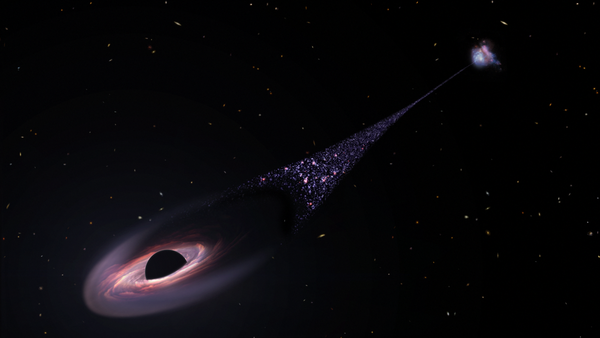
What’s invisible, weighs 20 million suns and zooms through space at more than 1,500 kilometers per second, leaving a long starry trail in its wake? If you guessed “a supermassive black hole that has escaped its host galaxy,” you’re probably right. At least that’s the conclusion of an international team of researchers who found and studied the candidate runaway using some of the world’s most powerful telescopes. The discovery is detailed in a paper published on April 6 in Astrophysical Journal Letters.
For reasons that are still poorly understood, supermassive black holes lurk at the centers of most large galaxies such as our own Milky Way. Despite their terrifying dimensions, these mysterious giants are usually quite inert and easy to overlook. They often only betray their presence with the celestial fireworks they create while swallowing immense volumes of gas and dust from their host galaxy.
All this makes supermassive black holes that have somehow “gone rogue” a strange and elusive breed. How do they escape their galactic host, and how can they be seen when they emit no light at all? Across the past decade, astronomers have only managed to identify a small number of other candidate nomads darkly drifting through the intergalactic depths—but none of these, the study authors say, are as convincing as their newfound escapee.
On supporting science journalism
If you're enjoying this article, consider supporting our award-winning journalism by subscribing. By purchasing a subscription you are helping to ensure the future of impactful stories about the discoveries and ideas shaping our world today.
That black hole was discovered by chance when it first appeared as a faint linear streak in a Hubble Space Telescope observation of globular clusters. Such features are usually artifacts of cosmic rays striking Hubble’s detectors, explains lead study author Pieter van Dokkum, an astronomer at Yale University. Further observations via the ground-based W. M. Keck Observatory on Mauna Kea in Hawaii revealed instead that the streak was a stream of young blue stars stretching across an astonishing 200,000 light-years.
That stellar stream is the clinching evidence, van Dokkum says. It’s presumably a kind of cosmic contrail that arose from a feedstock of gas that the onrushing black hole shocked and compressed into stars. The stream traces back arrowlike to a probable source galaxy some 7.5 billion light-years from Earth that shows no signs of now harboring a giant, feasting black hole at its core. “It has long been hypothesized that every galaxy is embedded in a vast reservoir of hydrogen gas,” van Dokkum says. “We think we’re seeing the black hole lighting up that gas as it speeds away, giving us a rare view of this elusive material.”
“From the ages of these stars,” he adds, “we deduce that the black hole escaped about 40 million years ago and is barreling through space at the very high speed of about 1600 kilometers per second.”
This speed is what excites many experts. “If this is a runaway black hole..., it is traveling very fast,” says University of Cambridge astronomy professor Christopher Reynolds, who did not participate in the study. So fast, in fact, that any explanation that does not involve a behemoth black hole running roughshod between galaxies would seem unlikely.
Even so, astronomers hope further observations using NASA’s James Webb Space Telescope and Chandra X-ray Observatory could eliminate any lingering doubts. “Much more data is needed to pinpoint this hypothesis,” says study co-author Maria Luísa Buzzo, a Ph.D. candidate at the Swinburne University of Technology in Australia. “We need additional data to confirm this scenario and to decrease the uncertainties on the nature of the [stellar stream] feature,” she says. Erin Bonning, an astronomer at Emory University, who was not involved with the work, agrees. “You’d want to see the direct gravitational effects of a compact, massive object,” she says.
Such effects are crucial for explaining how something weighing millions or billions of suns can be kicked out of a galaxy in the first place. Astronomers have long known that big galaxies can grow from collisions and mergers of smaller ones. Giant galaxies can merge with one another, too, forcing the black holes at their respective centers into close proximity. “We don’t know very well what happens next,” van Dokkum says. “Over 50 years ago it was proposed that sometimes these black holes could be dislodged from the center in the aftermath and even flung out of galaxies altogether. This observation seems to confirm that idea, giving us insight into what happens when arguably the most awesome objects in the universe come together.”
If two black holes become locked in a gravitational dance and then a third crashes in, the resulting instability can hurl one of the trio away at sufficient speed to exit the host galaxy entirely. Another possibility is that, rather than three black holes scattering off one another like billiards, two coming together as one could suffice. “The second channel involves two black holes merging and emitting gravitational [waves],” says Avi Loeb, an astrophysicist at Harvard University, who was not involved with the paper. “When they plunge toward each other, the [gravitational waves] will have a preferred direction in the common case when the two black holes do not have identical masses. As a result, the merger remnant will recoil in the opposite direction to conserve momentum.”
How exactly supermassive black holes manage to reach intergalactic space may have important implications for the host galaxies they leave behind. For instance, the black holes may suppress—or promote—further bouts of star formation. Finding more of them whizzing across the cosmos could thus give researchers a powerful new tool to learn more about how galaxies are born, grow and even eventually die. The curious specifics of this latest candidate—serendipitously spied as a starry “scratch” on a Hubble image—lead Bonning and other experts to suspect that evidence for other similar escapees may already exist, as-yet-unnoticed and awaiting discovery in other data sets.
“If this is actually what’s happening, and if this is common enough, you can just go and systematically search for this kind of thing,” Bonning says. Augmented by machine learning to pick out the telltale streaks, future panoramic surveys from upcoming facilities such as NASA’s Nancy Grace Roman Space Telescope and the ground-based Vera C. Rubin Observatory could perhaps reveal a treasure trove of these objects—each, in Bonning’s words, “a needle in a haystack that you can’t see.”