
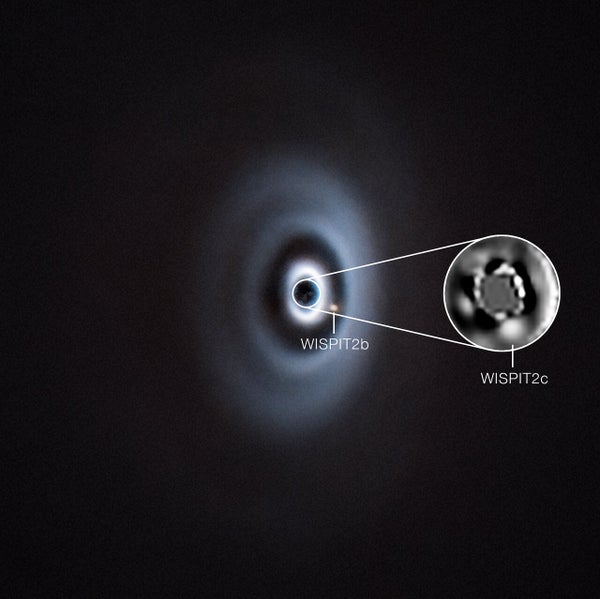
Planets around other stars can help answer one of the greatest mysteries: How did we get here? How did the spinning disk of material left behind by our sun’s birth form our planet and its seven neighbors? Typically astronomers find planets of similar ages to the ones in our solar system, but that’s starting to change.
In a study published today in the Astrophysical Journal Letters, astronomers reveal a baby solar system forming around a star some 437 light-years from Earth—it is only the second ever to be confirmed. The first, PDS 70, was discovered in 2018.
“This is a really exciting discovery,” says Jason Wang, an astronomer at Northwestern University who wasn’t involved in the research. “In astronomy, we often joke that when we have a sample size of one, we have an anomaly, but when we have a sample size of two, we have a population.”
On supporting science journalism
If you're enjoying this article, consider supporting our award-winning journalism by subscribing. By purchasing a subscription you are helping to ensure the future of impactful stories about the discoveries and ideas shaping our world today.
Some of the astronomers behind the new study revealed last year that the star, called WISPIT 2, had a protoplanet forming around it, WISPIT 2b. It marked the first time a baby planet had been imaged in a protoplanetary disk. Now they believe there are two gas giant planets, with the second about 10 times the size of Jupiter.
And the authors think there are more protoplanets to find around WISPIT 2. The star appears to be surrounded by a more extensive, structured ring of matter than PDS 70. And further out in the disk, the astronomers have spotted a third, smaller break in the material—a tantalizing hint that matter there may have already collapsed into a planet closer to Saturn’s size. The new finding was made using the European Southern Observatory’s Very Large Telescope in Chile’s Atacama Desert, and the authors hope that its successor, the Extremely Large Telescope, will be able to snap photos of the third hypothetical infant.
“These structures suggest that more planets are currently forming, which we will eventually detect,” says Chloe Lawlor, a Ph.D. student at the University of Galway in Ireland and the study’s lead author. By studying this new planetary nursery and others like it, astronomers hope to get a tighter grasp on how our own solar system came to be.
For her part, Lawlor is surprised to have led such a groundbreaking study as a young scientist. “Often there is a lot of self-doubt for people at my career stage,” she says. “I hope this discovery helps others to realize that while they might not know it all yet, they still know enough to do big things.”