
A debate has raged for decades over whether male fertility is declining, according to some analyses of studies from recent decades. It’s an alarming possibility, and likely one reason at-home semen analysis is a growing field of research and product development.
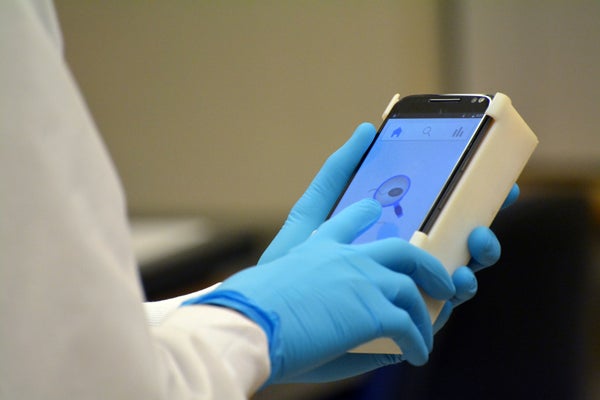
The latest study of a new at-home test kit, published today in Science Translational Medicine, found that even untrained users were able to measure sperm count and concentration as well as motility (the percentage of actively moving sperm), detecting abnormal semen with 97 percent accuracy compared with traditional lab testing. Developed by researchers at Harvard Medical School, the system uses a smartphone app with a 3-D–printed optical attachment to record a video of sperm cells in a sample. Software algorithms then analyze the video to count the sperm and assess their movement.
The user simply slides the brick-shaped magnifying optical attachment onto the back of a smartphone, then loads a semen sample into a disposable microchip device that looks like a flattened eyedropper, which is inserted into a slot in the device. The app records a one-second video of the sample, which appears on the screen, showing the swimmers in action. According to study co-author Hadi Shafiee, the kit costs about $5 to make and yields results—how many sperm there are and how well they move—in seconds. It also does not require internet access, and Shafiee hopes consumers will pay less than $50 for the whole kit. (Men who want to monitor their sperm over time can also keep the optical attachment and just replace the disposable microchips). Researchers say the product could be used by men in developing countries; those who cannot afford laboratory tests or those who are hesitant to go to a lab.
On supporting science journalism
If you're enjoying this article, consider supporting our award-winning journalism by subscribing. By purchasing a subscription you are helping to ensure the future of impactful stories about the discoveries and ideas shaping our world today.
Clinical fertility tests for men not only require the patient to produce a semen sample in a lab, which can be embarrassing and uncomfortable, they can also be costly—for the patient as well as for the facility. Tests rely on either expensive equipment for computer-assisted analysis or, in hospitals that cannot afford thousands of dollars’ worth of machinery, a technician who analyzes sperm cells under a microscope, a process Shafiee says can be subject to human error.
The race is on to create an optimal at-home product that is affordable, easy to use and effective. Earlier commercially available tests such as SpermCheck and Trak could measure sperm count and sperm concentration, but these were either expensive or offered less detailed results, says Kristian Almstrup, senior scientist at Rigshospitalet in Copenhagen who was not involved with the study. In contrast, newer kits, like the Harvard researchers’ creation and Yo Home Sperm Test, a device that went on sale last week, cannot only count sperm and measure its concentration, but can also assess its motility. Almstrup says the Harvard work is one of the more comprehensive studies of one of these at-home tests he has seen so far, however, with samples from 350 men analyzed.
Almstrup also points out there can be more problems with sperm than just low numbers or poor motility. In fact, scientists have been working to update lab tests to look beyond sperm count, swimming ability and shape (also known as morphology, a subjective measure that is tough to replicate with an algorithm) to explore other possible causes of male infertility.
James Smith, director of male reproductive health at the University of California, San Francisco, who also was not part of the research, agrees these at-home tests cannot offer a full picture of male fertility. “For that, you’d have to have to either talk to a specialist or have some other resources built into the app,” Smith says. He suggests the app could also direct users to doctors in the area. But he says at-home tests may be a good first step in getting patients to consider seeking fertility treatment as well as getting men more involved in searching for infertility solutions.
According to the National Institutes of Health, infertility problems are equally likely to be traced to men and women. Shafiee says the responsibility usually falls on the female partner, however. “Mostly women go through the process of fertility care, and men are [too] embarrassed to.”
Smith says there are lots of reasons men do not seek treatment for infertility but he thinks tools like these might encourage more men to check their sperm more regularly. He also sees public health applications, which could yield a more definitive measure of national fertility. “One of the problems is that in the United States there’s no national database [for tracking] infertility across everybody,” he says. “If you had something really simple like this, you could actually measure the overall reproductive health of a population in a pretty simple, low-cost way.”