
CLIMATEWIRE | Slovenia and Venezuela are the first two countries to lose their last-standing glaciers in a period of climate change induced by people — but they won’t be the last.
Some news outlets reported this month that Venezuela might be the first country in modern times to lose all of its glaciers. However, researchers told E&E News that Slovenia likely claimed the solemn title more than three decades ago.
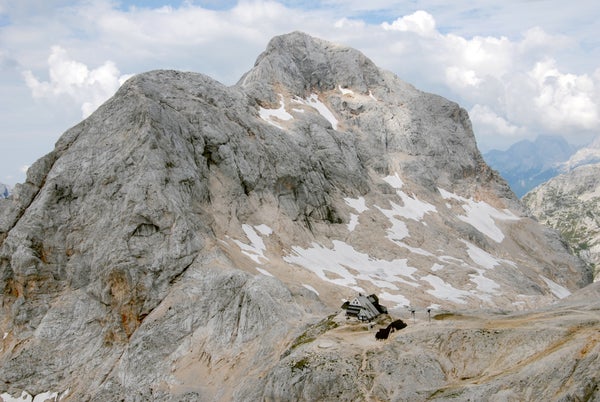
“The two glacial remnants have not moved, [and] there were no glacial crevasses observed in the last few decades — these characteristics define real glaciers,” Miha Pavšek, who leads ice measurements at Slovenia’s Triglav mountain and Skuta peak with the Anton Melik Geographical Institute, told E&E News.
On supporting science journalism
If you're enjoying this article, consider supporting our award-winning journalism by subscribing. By purchasing a subscription you are helping to ensure the future of impactful stories about the discoveries and ideas shaping our world today.
Melting glaciers are one of the iconic consequences of human-caused climate change, and even Arctic countries like Iceland have lost whole glaciers. But Slovenia and Venezuela appear to be the first countries since the 18th century to lose their last glaciers. It comes as the Intergovernmental Panel on Climate Change expects 18 to 36 percent of global glacial mass to be lost across the 21st century due in large part to global warming.
A May post on X, formerly Twitter, by climatologist Maximiliano Herrera drew attention to the decline of La Corona — Venezuela’s last glacier — by citing December measurements from the Universidad de Los Andes showing a remaining area of 0.02 square kilometers.
“The disappearance of all the glaciers in Venezuela is a national tragedy,” Julio César Centeno, a professor at Universidad de Los Andes who studied the glaciers, told E&E News in an email. “It is a warning sign about the avalanche of additional effects that are coming to the country in the short term as a consequence of global warming.”
But Slovenia and Venezuela likely lost their last glaciers years earlier.
There’s no universally accepted point of death for a glacier, and no international organization is recognized as the authority on glacial classification. But Centeno said that "the minimum size for a glacier is 0.1 [square kilometers.]" The United States Geological Survey also uses that threshold and says it’s “the commonly accepted guideline.”
In Slovenia, Skuta’s area has been under 0.1 square kilometers since at least 1969, and Triglav fell under the threshold in 1986. La Corona, in Venezuela, likely lost its glacial status in 2016.
Pavšek and Centeno say that beyond the size threshold, the remnant glaciers in Slovenia and Venezuela aren’t acting like they used to.
“Two basic characteristics for the real glaciers are their moving and the presence of glacial crevasses,” Pavšek said, adding that Triglav and Skuta have not possessed either “in the last few decades.” The amount of ice at the peak of Triglav is “the area of two volleyball courts,” while Skuta’s shaded position has afforded it double that surface area: 0.01 square kilometers.
The low altitude and latitude of both glaciers made them “more vulnerable to climatic extremes” and they succumbed to “rising temperatures,” Pavšek said. The Anton Melik Geographical Institute expects both summits to be ice-free by 2030.
Centeno said that after further melting in 2022, Venezuela’s La Corona is a shell of its former glacial status. La Corona, he said, is “an unburied corpse in an advanced state of decomposition.”
The loss of these glaciers and those to follow will carry heavy environmental consequences.
The Slovenian glaciers both melt into the Black Sea and La Corona empties into the Caribbean, contributing to rising global sea levels that are expected to wreak havoc on coastal communities.
“It is also a clear and resounding warning for the rest of Latin America,” Centeno said. “The consequences of the inevitable loss of the glaciers of Colombia, Ecuador, Peru and Bolivia will have a social impact much greater than that of Venezuela, due to the dependence of much larger populations on water sources dependent on these glaciers.”
Mexico’s last glacier, Gran Norte, is expected to lose its status sometime between 2026 and 2033 and be completely gone by 2045. Its runoff has provided downstream communities with water for centuries.
La Corona was the last of the “Five White Eagles” — glaciers that capped the mountains above the city of Mérida. Centeno sees its demise as a call to action on climate change: “What are we waiting for to act?”
“Mérida is no longer the City of Eternal Snows. The Five White Eagles have disappeared. We have destroyed them, annihilated them. They are among the first Venezuelan victims of global warming. Many others gather at the gates of extermination. Not only plants, animals, water sources and fertile soils, but humans, many humans,” Centeno said.
Reprinted from E&E News with permission from POLITICO, LLC. Copyright 2024. E&E News provides essential news for energy and environment professionals.