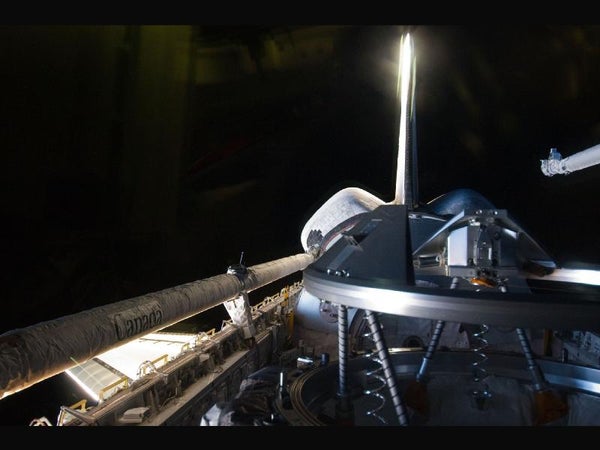
Atlantis Docks with Space Station for Last Time
In this photo , taken by an STS 135 mission crew member from inside the cabin, Atlantis is about to dock with the International Space Station (ISS) on the third day of NASA's final space shuttle mission.
On supporting science journalism
If you're enjoying this article, consider supporting our award-winning journalism by subscribing. By purchasing a subscription you are helping to ensure the future of impactful stories about the discoveries and ideas shaping our world today.
In this photo, taken by an STS 135 mission crew member from inside the cabin, Atlantis is about to dock with the International Space Station (ISS) on the third day of NASA's final space shuttle mission.
Atlantis's payload bay and docking mechanism are in the foreground. The robotic arm, built in Canada, is visible in the upper right corner. Its reach is extended by a boom that has been added since the Columbia disaster to enable astronauts to inspect the shuttle's reentry tiles for damage.
NASA released this image on July 12, while ISS Expedition 28 flight engineers Mike Fossum and Ron Garan were just beginning the mission's only planned spacewalk. They successfully retrieved a faulty ammonia pump and packed it into Atlantis's cargo bay for examination and refurbishment back on Earth. They also installed components of a new experiment designed to demonstrate satellite refuel and repair in space. The spacewalk lasted six hours and 31 minutes.
-- Lauren F. Friedman
It’s Time to Stand Up for Science
If you enjoyed this article, I’d like to ask for your support. Scientific American has served as an advocate for science and industry for 180 years, and right now may be the most critical moment in that two-century history.
SciAm always educates and delights me, and inspires a sense of awe for our vast, beautiful universe. I hope it does that for you, too.
If you subscribe to Scientific American, you help ensure that our coverage is centered on meaningful research and discovery; that we have the resources to report on the decisions that threaten labs across the U.S.; and that we support both budding and working scientists at a time when the value of science itself too often goes unrecognized.
In return, you get essential news, captivating podcasts, brilliant infographics, can't-miss newsletters, must-watch videos, challenging games, and the science world's best writing and reporting. You can even gift someone a subscription.
There has never been a more important time for us to stand up and show why science matters. I hope you’ll support us in that mission.