
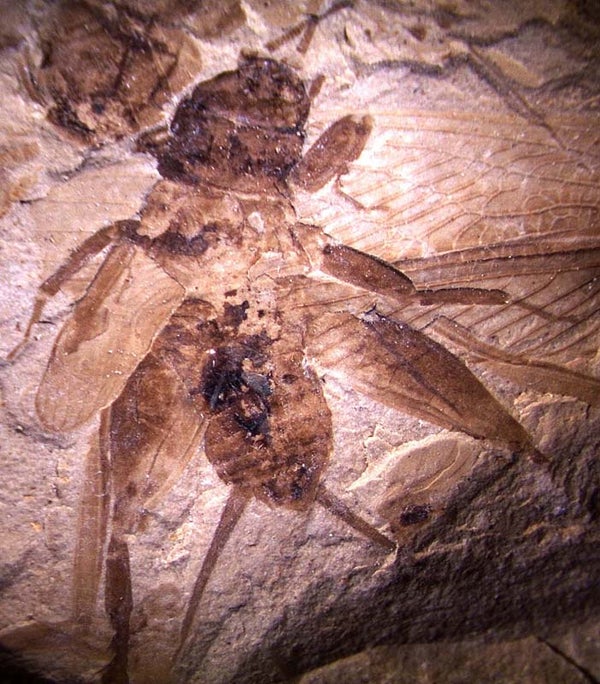
Insects have weird ears. Their seemingly random placement sometimes recalls a genetic experiment gone awry. Insect's auditory organs can be found on their stomachs, elbows—even wings.
Crickets' and katydids' ears, for instance, are on their front legs. And Dena Smith, a paleontologist from the University of Colorado at Boulder, has just published a paper in the Journal of Paleontology that found those same pinhole ears on 50-million-year-old crickets and katydids preserved in the fossil record.
Smith and her co-author Roy Plotnick from the University of Illinois at Chicago in their paleontological quests seek insect ears in the fossil record—organs that may reveal telltale hints of evolutionary history. Although they knew that the insects had ears back then, they were not sure how easy it would be to find them in fossils. "It hadn't really been documented before that you could find them" Smith says. But in fact, they found their ear hunt easier than expected on Eocene epoch specimens from Colorado, Wyoming and Utah. Cricket and katydid ears are visible to the naked eye as little pinholes on the insects' front legs. The hardest part was finding fossils in which the legs were still intact, and not covered by the wings.
On supporting science journalism
If you're enjoying this article, consider supporting our award-winning journalism by subscribing. By purchasing a subscription you are helping to ensure the future of impactful stories about the discoveries and ideas shaping our world today.
It's a bit counterintuitive, Plotnick says, but they often do not want the best fossils. "The classic, 'my god what a gorgeous fossil,' is beautiful to look at," he says, "but it's too complete, the ears are hidden." But once the legs are showing, Smith says, it was clear. "For those who did have legs, we could see the ears—no problem."
Now that they know they can spot the ears, Plotnick and Smith hope to start looking at the ways in which the interaction between predator and prey shaped insect evolution. Katydids and crickets communicated with one another long before bats—über insect predators—arrived on the scene, so the insects' ears were already well formed. But other species like moths are thought to have evolved ears solely in response to bats. "Anything that flies at night has to worry about bats—but that wasn't true before bats evolved," Plotnick says*. Now that they know they can find fossilized ears, they can start looking for them on specimens like moths and grasshoppers, to see how evolution proceeded after the arrival of bats—the master echolocators—complicated their lives.
— Rose Eveleth
*Editor's Note (1/10/12): This sentence was revised after posting.