
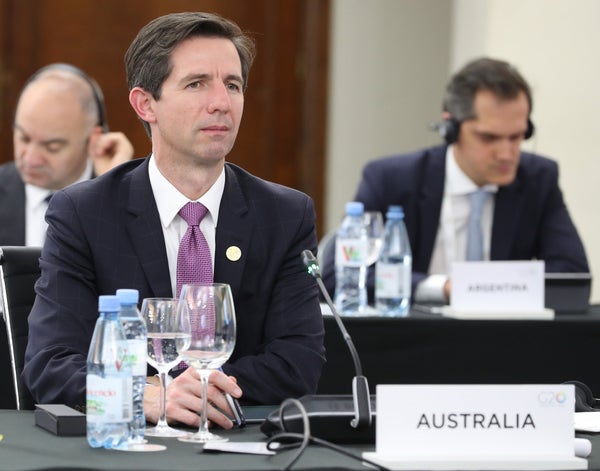
Australian universities and researchers have condemned the actions of a government minister who vetoed projects that had been selected for funding by expert panels. Academics say that the government’s interference has undermined the integrity of the peer-review system and could damage the country’s reputation as a desirable place to do research.
Last week, it emerged that in June 2018 and November 2017, Simon Birmingham, the then-minister for education, used his ministerial powers to stop funding for 11 humanities research projects, worth a combined AUS$4.2 million (US$3 million).
“I am confident that in each and every case rejected the vast majority of Australian taxpayers would believe the millions of dollars involved were better redirected to other research projects," Birmingham said in a statement to Nature yesterday.
On supporting science journalism
If you're enjoying this article, consider supporting our award-winning journalism by subscribing. By purchasing a subscription you are helping to ensure the future of impactful stories about the discoveries and ideas shaping our world today.
Birmingham’s intervention went against the recommendations of independent peer-review panels that had assessed the projects as high-quality and worthy of funding from the Australian Research Council, a major funder of science, as well as humanities, research.
Although the projects are all in the humanities, with titles such as “Price, metals and materials in the global exchange”, “Greening media sport” and “Rioting and the literary archive”, scientists are worried that the minister's actions undermine the country's competitive research funding system in which experts are used to select the best projects.
“We rely on subject experts to judge the best research in their field, not politicians,” says Catriona Jackson, the head of Universities Australia, a body representing Australia’s 39 universities.
The education minister has the power to reject recommended projects, but the right is rarely exercised. Science and humanities groups say that Birmingham should have respected the panel's recommendations. They also say he should have disclosed the cancellation of the projects publicly at the time—and given clear reasons why.
But Birmingham's decisions only came to light when the head of the ARC, Susan Thomas, was asked a question about one of the grants that had been rejected during a public hearing on government expenditure on 25 October.
Birmingham, who is now trade minister and was not at the hearing, has not provided reasons why he vetoed these particular projects, nor is he required to by ARC funding rules. On 26 October, he tweeted: "I'm pretty sure most Australian taxpayers preferred their funding to be used for research other than spending $223,000 on projects like “Post orientalist arts of the Strait of Gibraltar.”
Birmingham did not respond to Nature’s questions regarding concerns that his decision had undermined the peer-review process or the lack of transparency surrounding his decision.
The last time an education minister vetoed projects was in 2005, when then-education minister Brendan Nelson rejected up to 20 recommended grant applications.
Reputation damage
Academics worry that Birmingham's decisions may affect Australia's standing in the international research community.
“Through his actions, the Minister has opened the doors for political influence to affect funding outcomes,” said Emma Johnston, president of Science & Technology Australia, which represents 70,000 scientists across the country, in a statement. “When the very best research is no longer the research that gets funded, it threatens our ability to compete on the global stage as an innovation nation,” she said.
President of the Association of Australian Medical Research Institutes, Tony Cunningham said in a statement that the minister’s interference risks making Australia a laughing stock of the international research community.
The Australian Academy of Science told Nature that it is concerned that the incident will have a negative impact on the reputation of Australia as a place to undertake research or engage in research collaborations. The Academy says there should be a clear and transparent justification for a minister deciding to use this power.
The incident is also likely to jeopardize researchers’ trust in the research council’s peer-review process, which relies on reviewers devoting huge amounts of time and goodwill, says Darren Saunders, a cancer researcher at the University of New South Wales in Sydney. “I’m already hearing that this is undermining people’s goodwill towards that system, it’s undermining the trust in the system,” says Saunders.
Personal impact
One of the researcher’s whose project was rejected, Mark Steven, says that the minister’s decision had a significant effect on his family. When he didn’t secure the grant in November 2017—Steven wanted to investigate the extent to which the Russian Revolution and the socialist state had informed commercial film-making in Hollywood—he was on a short-term contract.
To secure a permanent job, he left Australia to take up a position at the University of Exeter, UK. Although the job is a great opportunity, he says, it meant moving his family to the other side of the world and leaving his support networks behind. “We struggle on a daily basis with the challenges of having to undertake that move,” Steven says.
Science groups are now calling on education minister Dan Tehan to ensure that the peer-review process is respected for the 2019 Australian Research Council grant awards, which are expected to be announced in the next few weeks.
This article is reproduced with permission and was first published on October 30, 2018.