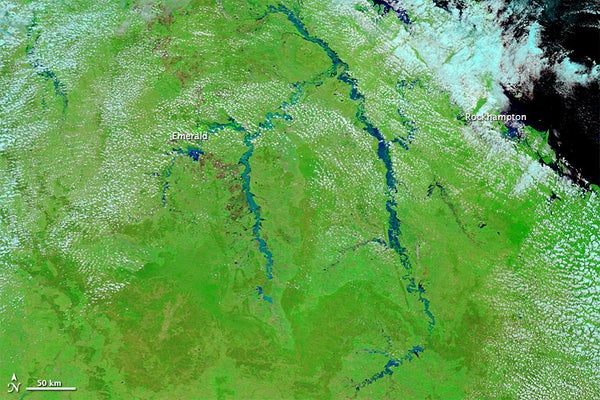
Australian floods inundate Queensland towns

The northeastern Australian state of Queensland remains burdened by deadly floods that have affected hundreds of thousands of residents in the past several days.

MODIS Rapid Response Team/NASA GSFC

Join Our Community of Science Lovers!


On supporting science journalism

If you're enjoying this article, consider supporting our award-winning journalism by subscribing. By purchasing a subscription you are helping to ensure the future of impactful stories about the discoveries and ideas shaping our world today.


The northeastern Australian state of Queensland remains burdened by deadly floods that have affected hundreds of thousands of residents in the past several days.

A tropical cyclone and heavy rainfall around Christmas inundated numerous river basins, affecting 200,000 people across an area larger than Texas or France, according to the Associated Press. Four people have been killed in the deluge, and six others in the state have succumbed to floods since late November, according to the Sydney Morning Herald. The newspaper reports that 22 central Queensland towns are underwater or cut off by the floodwaters.

The Earth-observing Terra satellite, managed by NASA for an international consortium, photographed the swollen Fitzroy, Mackenzie, Comet and Dawson rivers in Queensland on December 31. At Rockhampton, a city on the Fitzroy with more than 60,000 residents, military aircraft are bringing in supplies after road closures cut the city off from the rest of the state. And floodwaters are still rising at Rockhampton; the Australian Bureau of Meteorology expects the river's height will peak at up to 9.4 meters there on January 5.

It’s Time to Stand Up for Science

If you enjoyed this article, I’d like to ask for your support. Scientific American has served as an advocate for science and industry for 180 years, and right now may be the most critical moment in that two-century history.

I’ve been a Scientific American subscriber since I was 12 years old, and it helped shape the way I look at the world. SciAm always educates and delights me, and inspires a sense of awe for our vast, beautiful universe. I hope it does that for you, too.

If you subscribe to Scientific American, you help ensure that our coverage is centered on meaningful research and discovery; that we have the resources to report on the decisions that threaten labs across the U.S.; and that we support both budding and working scientists at a time when the value of science itself too often goes unrecognized.

In return, you get essential news, captivating podcasts, brilliant infographics, can't-miss newsletters, must-watch videos, challenging games, and the science world's best writing and reporting. You can even gift someone a subscription.

There has never been a more important time for us to stand up and show why science matters. I hope you’ll support us in that mission.

Thank you,

David M. Ewalt, Editor in Chief, Scientific American

Subscribe