
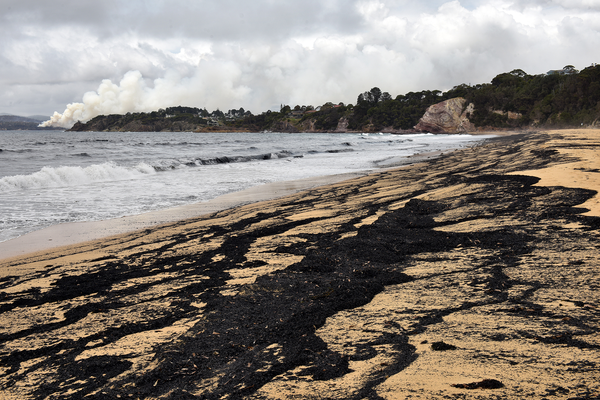
As wildfires ravage Australia’s land and forests, so far killing an estimated one billion terrestrial animals, researchers worry marine and freshwater species will become invisible victims.
More than 17.1 million hectares of land have burned across the country, with the worst fires currently raging in New South Wales and Victoria, states in the nation’s southeast, according to Australia’s Department of the Environment and Energy (DEE). Adrian Meder, a marine campaigner at the Australian Marine Conservation Society (AMCS), says these fires are leaving behind a huge number of charred plants and a massive amount of ash.
Though Australia is in the midst of a massive drought, when the rain inevitably returns—as it already has in some regions—this organic matter will rush into rivers and flow into coastal lakes, estuaries, and seagrass and seaweed beds.
On supporting science journalism
If you're enjoying this article, consider supporting our award-winning journalism by subscribing. By purchasing a subscription you are helping to ensure the future of impactful stories about the discoveries and ideas shaping our world today.
The free-flowing silt will get into fish’s gills and block sunlight that seagrass and seaweed beds need for photosynthesis, effectively strangling them. “It’s essentially like putting a shade cloth all over the entire system,” says Leonardo Guida, a shark campaigner with AMCS.
The slurry of potassium, phosphorus, and nitrogen will also cause algae in the water to bloom. The algae will consume the oxygen in the water, suffocating species that rely on it.
The fires have also torched many forests near the coast, destroying plants that filter silt and excess nutrients. The ecosystems are adapted to the low nutrient flows from the land, Meder explains. But “these fires have effectively clear-felled areas on a scale that hasn’t been seen before.”
Many commercial aquatic species, such as flathead, snapper, prawns, and various shellfish, begin their lives in coastal lakes and seagrass and seaweed beds. These coastal habitats are also spawning areas for species, including seahorses, and their degradation could send ripples throughout the larger ecosystem, the researchers say.
Some of these effects are already being felt. In southern New South Wales and Victoria and on Kangaroo Island, the fires are causing problems for fisheries and aquaculture, according to DEE.
When the rain began in the Central Coast region of New South Wales, members of the Darkinjung, a local Aboriginal land council, set up barriers to keep the deluge of silt- and ash-filled water out of the region’s rivers, lakes, and estuaries. According to Kelvin Johnson, a senior land management officer with the Darkinjung, they have already seen some dead fish in nearby rivers.
The wildfires and their aftermath have caused and could continue to cause cultural damage as well, Johnson says.
Australia’s Indigenous peoples, Johnson says, use sacred songlines—a complex mix of celestial references, songs, oral history, and physical and cultural landmarks—to navigate terrestrial and aquatic routes. Though it’s too early to know the extent of the damage, Johnson says if the fires harm oysters, crustaceans, flathead, or mullet, that would mark a loss of these cultural touchstones.
Last month, Australia’s federal government announced an AU $50-million (US $35-million) recovery fund (part of its AU $2-billion bushfire fund) to restore and protect damaged ecosystems and wildlife. But there has been no funding dedicated to marine and aquatic areas, Guida says. DEE notes that some of those funds may go to emergency interventions, such as erosion control, to stem sediment flows into aquatic ecosystems.
The ocean and the coast need dedicated help, Guida says. Though the devastation on land is much more visible, the health of the ocean and the land are intrinsically tied together.
This story originally appeared in Hakai Magazine and is republished here as part of Covering Climate Now, a global journalism collaboration to strengthen coverage of the climate story.