
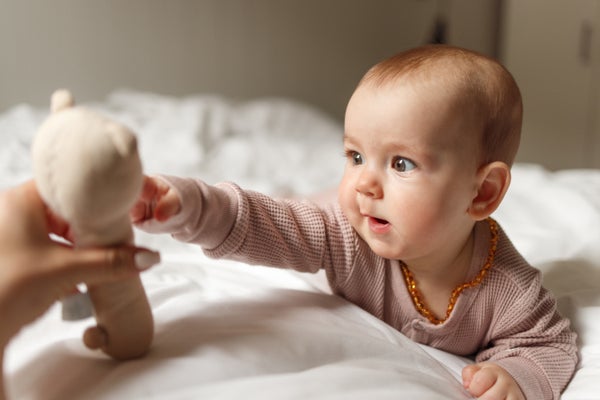
Babies as young as one year old can form memories, according to the results of a brain-scanning study published today in Science. The findings suggest that infantile amnesia — the inability to remember the first few years of life — is probably caused by difficulties in recalling memories, rather than creating them.
“One really cool possibility is that the memories are actually still there in adulthood. It’s just that we’re not able to access them,” says study co-author Tristan Yates, a neuroscientist at Columbia University in New York City.
Memory mystery
On supporting science journalism
If you're enjoying this article, consider supporting our award-winning journalism by subscribing. By purchasing a subscription you are helping to ensure the future of impactful stories about the discoveries and ideas shaping our world today.
Try as they might, adults can’t remember events from their earliest months or years. But whether this is because a baby’s hippocampus, a key brain region in storing such memories, is not sufficiently developed or because adults cannot recall these memories has long been an open question.
To shed light on the issue, Yates and her colleagues used functional magnetic resonance imaging (MRI) to scan the brains of 26 young children, aged 4 months to 2 years, who were performing a task involving memory.
The team measured hippocampal activity as the children viewed an image of a new face, object or scene for 2 seconds, and when they were shown the same image again about a minute later.
They found that the greater the hippocampal activity when a baby was looking at a new image, the longer they looked at that image when shown it again. Because babies tend to spend more time looking at familiar things, this result suggests that they were remembering what they had seen.
The researchers saw the strongest encoding activity in the posterior part of the hippocampus — the area most associated with memory recall in adults.
“What this study shows is a proof of concept that the encoding capability exists,” says study co-author Nick Turk-Browne, a cognitive psychologist at Yale University in New Haven, Connecticut.
“Although we saw this across all the infants in our study, the signal was stronger in those older than 12 months of age, suggesting a kind of developmental trajectory for the ability of the hippocampus to encode individual memories,” says Yates.
The work is impressive, says Amy Milton, a behavioural neuroscientist at the University of Cambridge, UK. “It can’t have been straightforward to get data from children that young. It definitely supports this idea that the immature hippocampus is capable of doing at least some kind of episodic memory encoding.”
Forgotten, but not gone
The inability of adults to remember their earliest years therefore seems to be a recall problem, which could be caused by a “mismatch between how the memory was initially stored and the retrieval cues or the search terms that your brain is using to try to get back to the memory,” says Turk-Browne.
This could be due to the fact that babies’ experiences are so different from those in later years, when the brain can put what we see and hear into context and categorize it accordingly. “Even just going from crawling to walking changes your whole view of the world,” says Yates.
Studies in rats support the idea that memories from early childhood can stick in our brains for years. In a 2016 study, neuroscientists used a technique called optogenetics to activate the neurons encoding infant memories in adult rats, showing that the memories still exist, says Turk-Browne. “We can’t do that in humans, but that’s the best evidence that the memories are there.”
This article is reproduced with permission and was first published on March 20, 2025.